Nile Crocodile: Size, Behavior and Where to See Them Safely
The Nile crocodile is one of Africa’s oldest surviving predators and a dominant force in river ecosystems across East Africa. It is also one of the most efficient ambush hunters in the world, combining patience, explosive speed, and immense bite force. Despite its slow, almost motionless appearance while basking, it is capable of sudden acceleration that makes it extremely dangerous in water and at the water’s edge.
In safari destinations such as the Masai Mara National Reserve and the Serengeti National Park, Nile crocodiles are a constant presence in river systems where they play a crucial ecological role as apex aquatic predators.
Understanding their biology, behavior, and habitat preferences is essential for safe and informed wildlife viewing.
Physical size and strength of the Nile crocodile
The Nile crocodile (Crocodylus niloticus) is the largest freshwater predator in Africa and one of the largest crocodile species globally.
Adult males typically range from 3.5 to 5 meters in length, although exceptional individuals can exceed this. Their body mass can reach several hundred kilograms, with large males possessing extraordinary muscular power concentrated in the jaw and tail.
The bite force of a Nile crocodile is among the strongest in the animal kingdom, designed to crush bone and hold onto struggling prey with minimal energy expenditure.
Their physical design has remained largely unchanged for millions of years, making them one of the most evolutionarily successful predators on Earth.
Habitat and distribution in East Africa
Nile crocodiles are widely distributed across rivers, lakes, and wetlands throughout East Africa.
They are most commonly found in permanent water systems where prey is abundant and basking sites are available.
In safari ecosystems such as the Mara River in Kenya and Tanzania, crocodiles are especially prominent due to seasonal migration crossings.
They are also found in lakes and large river systems where fish populations provide a stable food source year-round.
Their dependence on water makes them highly localized but consistently present in suitable habitats.
Hunting behavior and ambush strategy
Nile crocodiles are ambush predators that rely on stealth rather than pursuit.
They typically remain submerged with only their eyes and nostrils visible, waiting for prey to approach the water’s edge.
When an opportunity arises, they launch a rapid burst of speed from the water, using their tail for propulsion and their jaws to secure the target.
One of their most well-known hunting techniques is the “death roll,” where they rotate their bodies rapidly to disorient prey and tear off manageable pieces.
This method allows them to overpower animals much larger than themselves.
Diet and feeding patterns
Nile crocodiles are opportunistic feeders with a broad diet that changes based on size and availability of prey.
Juveniles feed primarily on insects, small fish, and amphibians.
Sub-adults expand their diet to include birds and small mammals.
Adults are capable of taking large prey such as antelope, wildebeest, and even buffalo during river crossings.
Scavenging is also common, particularly when carcasses become available in river systems.
Their ability to survive long periods without food makes them highly efficient predators in unpredictable environments.
Crocodile behavior and energy conservation
Crocodiles are ectothermic, meaning they rely on external heat sources to regulate body temperature.
This is why they are often seen basking on riverbanks during the day.
Despite their size, they conserve energy by remaining motionless for long periods, sometimes for hours or days.
This inactivity is not a sign of weakness but a strategic hunting adaptation.
When prey approaches, crocodiles transition from stillness to explosive motion in a fraction of a second.
Social behavior and territoriality
Although crocodiles are often seen in groups, especially when basking, they are not highly social animals.
These aggregations are primarily driven by shared basking sites and feeding opportunities rather than cooperation.
Larger individuals tend to dominate prime basking locations and feeding zones, while smaller crocodiles are pushed to the periphery.
During feeding events, especially large kills, crocodiles may display aggressive competition, including biting and displacement behaviors.

Nile Crocodile
Nile crocodiles and river crossings
One of the most dramatic wildlife interactions involving crocodiles occurs during river crossings in ecosystems like the Mara River.
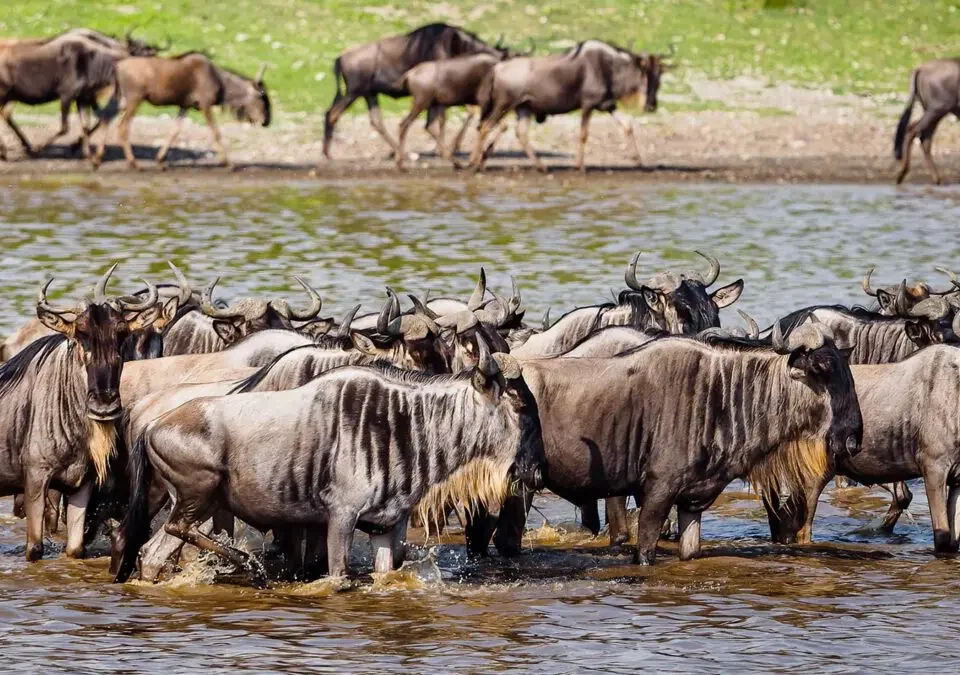
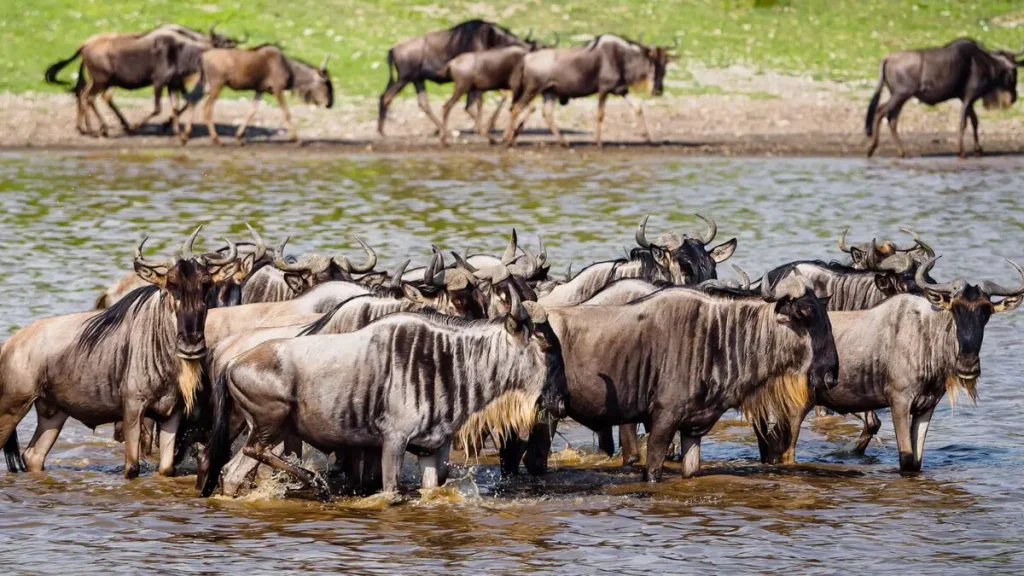
During the Great Migration, large herds moving through the river face significant predation pressure from crocodiles waiting in deep water channels.
These encounters are not random; crocodiles position themselves strategically in crossing points where movement is predictable.
The combination of herd panic and ambush positioning creates one of the most intense predator-prey dynamics in Africa.
Where to see Nile crocodiles safely
Crocodiles are widely distributed in East Africa, but safe viewing depends on distance, terrain, and guide expertise.
In the Masai Mara ecosystem, they are commonly seen along riverbanks, especially in deeper pools where water is slow-moving.
In the Serengeti system, crocodiles are frequently observed in permanent river sections where they bask on exposed banks.
The Ngorongoro Crater lakes also support smaller crocodile populations, though visibility varies depending on water levels.
In all cases, crocodiles are best viewed from safari vehicles or designated observation points, never from unprotected shorelines.
Safety considerations during crocodile viewing
Crocodiles are unpredictable near the water’s edge, especially when feeding or during territorial interactions.
Most incidents involving humans occur when individuals approach water too closely or attempt to cross shallow river sections without guidance.
Safari protocols maintain strict distance rules, particularly in known crocodile habitats.
Even when crocodiles appear inactive, they must always be treated as potentially reactive.
Crocodile interaction with other species
Crocodiles interact with a wide range of species in their ecosystem.
They are important scavengers, consuming carcasses that would otherwise decompose in water systems.
They also compete with other predators such as large fish-eating birds and occasionally with otters or monitor lizards for smaller prey.
However, their primary ecological role is as apex aquatic predators.
Role in ecosystem balance
Nile crocodiles play a key role in maintaining healthy aquatic ecosystems.
By preying on weak, injured, or vulnerable animals, they contribute to natural selection processes within river systems.
They also help regulate fish populations and maintain balance in aquatic food chains.
Their presence indicates a functioning, intact river ecosystem.
Growth and lifespan
Nile crocodiles grow throughout their lives, although growth slows significantly after maturity.
They can live for several decades in the wild, with some individuals reaching very advanced ages under stable conditions.
Their long lifespan contributes to generational dominance in certain territories, where large males maintain control over key river sections for many years.
Why crocodiles are considered apex ambush predators
Crocodiles combine three key traits that define apex ambush predators:
Stealth through near-complete submersion
Explosive burst speed over short distances
High success rate in surprise attacks
This combination makes them one of the most efficient hunters in African freshwater ecosystems.
Unlike many predators, they do not rely on chase or endurance but on timing and positioning.
The safari reality of crocodile viewing
For most travellers, Nile crocodiles are commonly seen but rarely in active motion.
They are often observed resting, basking, or partially submerged in river systems.
Active hunting events are rare to witness but highly dramatic when they occur.
The experience of seeing a crocodile is usually one of quiet observation rather than dynamic interaction.
However, the awareness of their potential speed and power adds intensity to even static sightings.
Why Nile crocodiles matter in East African safaris
Nile crocodiles are essential to understanding river ecosystems in East Africa.
They represent the final stage of aquatic predation and help maintain ecological balance in freshwater environments.
Their presence also shapes animal behavior around water sources, influencing migration routes, crossing points, and predator-prey interactions.
Even when motionless, they are an active force within the ecosystem.