

Every river has to start somewhere, and for more than a century the accepted answer for the world’s longest river has pointed straight at a stretch of water on the edge of a mid-sized Ugandan town. Jinja sits where Lake Victoria spills northward into what becomes the Nile, and that single geographic fact has shaped everything the town has become since: a colonial administrative post, an industrial hub built on sugar and hydroelectric power, and now the base camp for East Africa’s most concentrated cluster of adventure activities. Few places in Uganda pack this much history and adrenaline into one riverside town.
The Search for the Nile’s Source
Jinja’s place on the map owes everything to a claim made on 28 July 1862, when the British explorer John Hanning Speke reached the point where Lake Victoria drains northward and declared it the long-sought source of the Nile. Speke named the spot Ripon Falls, after the Marquess of Ripon, describing the original falls as “a magnificent sight, and much larger than I had imagined.” His claim was disputed for years afterward by rival explorers and geographers who favoured other tributaries and lakes further south, but Jinja’s falls remained the popularly accepted starting point of the river for the best part of a century.
How the Falls Disappeared
Ripon Falls no longer exists in any visible form. The completion of the Owen Falls Dam in 1954, now known as the Nalubaale Dam, backed up the river enough to submerge the falls entirely beneath its reservoir, trading a scenic waterfall for the hydroelectric power that still anchors Uganda’s national grid today. A second dam at Bujagali, commissioned in 2012, later flooded Bujagali Falls as well, a set of rapids that had by then become the country’s single most popular white-water rafting run. The rafting industry didn’t disappear with it; operators simply shifted downstream to newly exposed sections of river, and Jinja kept its reputation as the adventure capital of East Africa largely intact.
Visiting the Source Today
Despite the dam, the site where Speke stood remains Jinja’s most visited attraction, now laid out as landscaped gardens overlooking the water where the Nile visibly begins its journey north. A speedboat trip from the gardens takes visitors out to the exact point where the lake’s outflow becomes river current, a subtle but genuinely moving thing to witness once you know the geography behind it. The gardens also hold a statue of Mahatma Gandhi, placed there in recognition of his wish that a portion of his ashes be scattered in the Nile, which were indeed released at this spot after his death, giving the site a second, entirely different layer of significance for visitors who arrive expecting only a geography lesson.
From Colonial Outpost to Industrial Town
The British established Jinja in 1901 as an administrative centre for the wider Busoga region, but it was industry, not administration, that defined the town’s twentieth century. In 1912, a fourteen-year-old Indian trader named Muljibhai Madhvani arrived in Jinja and joined his brothers’ small trading business, building it over the following decades into an industrial empire that, at its peak, accounted for roughly a tenth of Uganda’s entire economic output. The Madhvani Sugar Works, established around 1930, became one of several large sugar and textile operations that turned Jinja into Uganda’s industrial engine, powered directly by electricity from the new dam at Owen Falls.
The 1972 Expulsion and Its Aftermath
That industrial base collapsed almost overnight in 1972, when President Idi Amin ordered the expulsion of Uganda’s entire Asian community, seizing Indian and Pakistani-owned businesses, including the Madhvani family’s holdings, and handing them to unqualified allies. Jinja’s economy never fully recovered from the loss of skilled management and investment that followed. When Amin himself was overthrown in 1979 and the political climate eventually stabilised, the Madhvani family returned to Uganda in 1985 and rebuilt much of their business from the ground up, a recovery that mirrors the town’s own slow return to relevance as a tourism and adventure destination rather than a pure industrial centre.
The Cultural Capital of Busoga
Long before Speke arrived, Jinja sat within the territory of the Busoga Kingdom, one of Uganda’s oldest traditional monarchies and, notably, a confederation rather than a single centralised chiefdom, made up of eleven hereditary chiefdoms that unite under one Kyabazinga, or king. The Kyabazinga’s palace sits on Igenge Hill overlooking the town, and it remains an active seat of cultural authority rather than a museum piece, hosting ceremonies and functioning as the point of reference for Basoga tradition and language in the wider region. Visitors who spend time in Jinja beyond the riverside activity operators will notice Busoga’s influence throughout the town, from local place names to the ceremonial role the kingdom still plays in regional affairs, a cultural layer that most rafting-focused itineraries skip entirely.
East Africa’s Adventure Capital
Modern Jinja’s reputation rests less on sugar and hydropower than on what the river now offers thrill-seekers. Sitting roughly 80 kilometres from Kampala, a drive of around two hours on a good road, Jinja has become the default weekend and add-on destination for travellers who want adrenaline built into an otherwise wildlife-focused Uganda trip.
On and Around the River
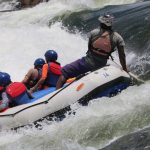
White-water rafting remains the headline activity, run on the sections of the Nile that still carry serious rapids below the two dams, and it draws both first-time paddlers and experienced rafters chasing genuinely world-class white water. A typical full-day run covers around nine rapids over roughly 20 kilometres of river, finishing at Itanda Falls, and includes a mix of grade four rapids alongside several graded five and, on the right stretch, one rated grade six, a classification high enough that even that single rapid is generally portaged rather than run. Bungee jumping operates from a 44-metre platform positioned directly over the river, giving jumpers a view of the Nile rushing beneath them in the final seconds before the drop. Kayaking and stand-up paddleboarding cover the calmer stretches for visitors who want river time without the rapids, and sunset boat cruises out of Jinja’s various landing sites give a gentler way to take in the same water from a deck chair rather than a raft.
On Land
Quad biking tours run along dirt tracks beside the river, weaving through small villages and farmland where riders get a far closer look at rural Ugandan life than a standard safari itinerary usually allows. Horseback riding safaris follow a similar route along the riverbanks, climbing into the hills above Jinja for panoramic views back down over the valley. Zip-lining, most famously through the canopy at nearby Mabira Forest, rounds out the area’s activity list for visitors who have already exhausted the water-based options.
Planning Your Time in Jinja
Getting There and Getting Around
Self-drivers and private transfers cover the roughly 80 kilometres from Kampala on a tarmac road in around two hours, making Jinja one of the most straightforward day-trip destinations from the capital. Public buses and shared taxis run the same route regularly from Kampala’s main bus parks for travellers without a private vehicle, and the fare is modest compared with the cost of reaching almost any other adventure destination in the country. Once in Jinja itself, the town is compact enough to walk between the market, the riverside cafes, and several operator offices, though the activity sites further out along the river generally require a boda-boda, a hired car, or transport arranged directly through whichever rafting or bungee company you’ve booked with.
Best Time to Visit
Jinja’s river-based activities run year-round, since the Nile’s flow through this stretch is controlled by the dams upstream rather than seasonal rainfall alone, which keeps rafting conditions relatively consistent regardless of when you visit. The drier months, broadly December through February and June through August, are still the most comfortable for the land-based activities like quad biking and horseback riding, since the dirt tracks used for both turn considerably muddier during the long and short rainy seasons. Travellers timing a visit around live music might also look out for the Nyege Nyege festival, an internationally known electronic and alternative music event held on the riverbank that has, in recent years, turned Jinja into one of East Africa’s more unexpected nightlife destinations for a few days each year.
Where to Stay
Accommodation ranges from riverside backpacker camps with dorm beds and tents through to considerably more comfortable mid-range lodges overlooking the water, giving Jinja a wider spread of price points than most single-activity adventure hubs manage. Most rafting and bungee operators are clustered around the same stretch of riverside road, making it straightforward to book multiple activities through one operator rather than coordinating transport between separate companies. Anyone combining Jinja with a broader Uganda itinerary should also budget time for nearby Mabira Forest, roughly midway between Jinja and Kampala, which pairs naturally with a Jinja stopover, and for a Nile perch fishing trip, since the same river that powers the rafting industry also holds some of the biggest freshwater fish in East Africa, covered in more detail in our guide to fishing for Nile perch at the source of the Nile. Travellers looking to combine Jinja with gorilla trekking and a deeper cultural itinerary can look at the 9-Day Uganda Gorilla Safaris, Jinja and Nile Cultural Experience, which already builds a Jinja stop into a wider trip, or read our piece on Mabira Forest for the rainforest stop most people fold into the same journey.













