Tree-Climbing Lions of Ishasha: Where and When to See Them
Lions are not supposed to climb trees. Their build, weight distribution, and claw structure are all optimised for a life spent almost entirely on the ground, which is exactly why the sight of a fully grown lioness draped along a horizontal branch, four to five metres up a fig tree, tail dangling below her, stops even seasoned safari guides mid-sentence. Uganda’s remote Ishasha sector is one of only two known places anywhere in Africa where this exact behaviour shows up reliably enough to plan an entire trip around it, and that rarity has turned a remote, hard-to-reach corner of Queen Elizabeth National Park into a genuine pilgrimage site for serious safari-goers willing to make the extra drive.
Why Lions Climb Trees at All
Researchers studying Ishasha’s lions have never settled on a single, definitive explanation for the behaviour, and the honest answer is that it’s probably driven by more than one factor working together rather than one tidy cause.
Escaping Biting Insects
One leading theory points to tsetse flies and other biting insects that swarm at ground level in this part of Uganda, with lions climbing above roughly three metres putting themselves largely out of reach of the worst insect activity while also catching cooling breezes that rarely reach the savannah floor.
Beating the Heat
Ground temperatures in Ishasha regularly climb past 35 degrees Celsius during the hottest parts of the day, and the shaded, elevated branches of a large fig or acacia tree offer a genuinely cooler resting spot than baking in direct sun on open grassland, making tree-climbing at least partly a straightforward thermal comfort strategy.
A Better View of Prey
A third theory focuses on hunting strategy rather than comfort: from an elevated branch, a lion gets a considerably wider vantage point over the open plains where Uganda kob, the antelope species that makes up much of the local lion diet, graze in herds that would otherwise be difficult to track from ground level through tall grass. Most researchers now treat the behaviour as a learned adaptation passed down within specific prides rather than an evolved trait, which is part of why it shows up so consistently in Ishasha’s resident lions while remaining rare or entirely absent in lion populations elsewhere in East Africa.
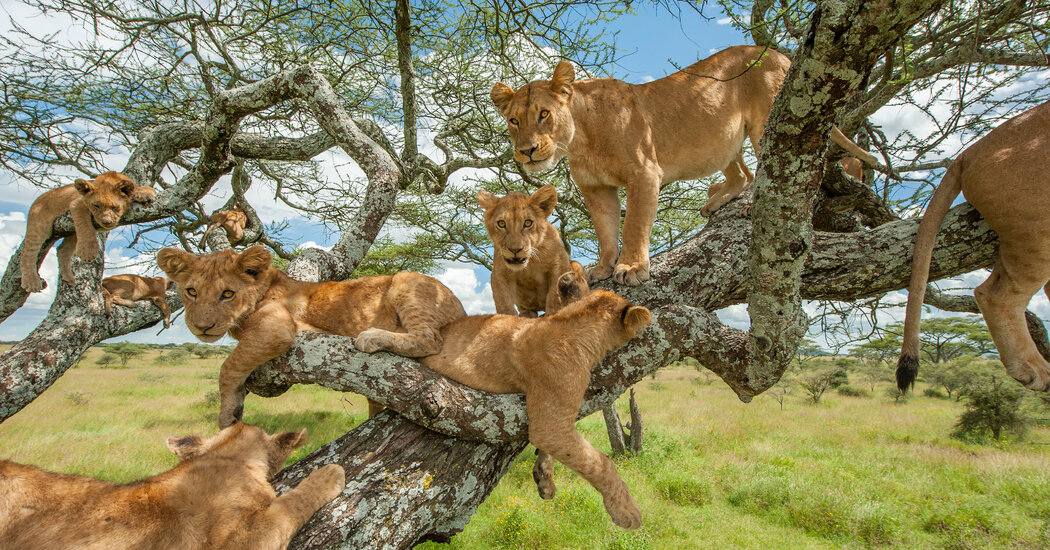
Tree-climbing lions of Ishasha resting on fig tree branches in Uganda’s Queen Elizabeth National Park
How a Sighting Actually Unfolds on a Game Drive
Finding a tree-climbing lion isn’t as simple as driving through Ishasha and looking up. Because the resident prides use a limited, well-known set of trees rather than climbing opportunistically anywhere across the sector, experienced guides work a rough circuit of these known spots, checking each one methodically rather than relying purely on chance. Radio communication between vehicles operating in the sector at the same time plays a real role here too, since one guide spotting lions up a tree will typically pass word to other vehicles nearby, meaning a group’s odds improve considerably during busier periods when more eyes are covering more ground simultaneously. Patience remains the one ingredient no amount of guide experience can fully substitute for, since a lion draped motionless along a branch for hours can be genuinely difficult to spot against dappled light and leaf cover even when a vehicle is parked directly beneath the right tree.
Where Exactly to Look
The Ishasha sector sits in the southwestern corner of Queen Elizabeth National Park, in Kasese District close to the border with the Democratic Republic of Congo, roughly two hours by dirt road from the main Mweya area where most of the park’s other activities are based. The lions favour a specific type of tree for this behaviour, most often large sycamore figs and broad acacias with strong horizontal branches capable of supporting an adult lion’s full weight comfortably, and guides operating in the sector know the handful of regularly used trees well enough to check them systematically on a game drive rather than searching blind across the entire area.
Only One Other Place on Earth
Ishasha shares its claim to fame with exactly one other location: Lake Manyara National Park in Tanzania, where a separate lion population has developed the same unusual habit. Beyond these two sites, tree-climbing behaviour in wild lions is documented only sporadically and unreliably elsewhere on the continent, which is precisely what makes Ishasha worth the extra driving time for photographers and dedicated safari travellers who specifically want this sighting rather than a general Queen Elizabeth game drive. Interestingly, the two populations aren’t connected in any way, separated by hundreds of kilometres and an international border, which strengthens the case that this is a learned, locally transmitted habit rather than some shared genetic trait passed down from a common ancestor population.
When to Visit for the Best Odds
Sightings are possible year-round, since the resident lions don’t migrate away from the sector, but the dry season windows, roughly June through September and again from December through February, offer the clearest advantage. Dry conditions concentrate both the lions and their kob prey more predictably around the same open grassland and tree lines, and firmer roads make the sector’s dirt tracks considerably easier to navigate than during the wetter months. Late morning through early afternoon, once the day’s heat has properly set in and the ground-level temperature argument for climbing kicks in fully, tends to produce the most reliable sightings, since this is when lions are most likely to have already retreated up into the branches rather than resting somewhere in the open grass below.
What Else Ishasha Offers Beyond the Lions
It would be a mistake to treat Ishasha purely as a single-species checkbox stop. The sector’s open grassland and riverine woodland support healthy populations of Uganda kob, the lions’ primary prey, along with topi antelope and a solid selection of savannah and woodland birdlife that rewards even a short stop between lion-tree checks. Its position hard against the DRC border also gives the landscape a remote, edge-of-the-map character that’s noticeably different from the more heavily visited Mweya area further north in the same park, appealing strongly to travellers who specifically want a quieter, less crowded stretch of Queen Elizabeth’s overall territory to explore at their own pace, away from the busier tour circuits closer to the park’s main entrance gates.
Photographing the Sighting
Getting a genuinely good photograph of a tree-climbing lion takes more consideration than a standard ground-level sighting. Shooting upward into a tree canopy often means fighting strong backlighting from the sky behind the animal, so positioning the vehicle to catch side or front lighting rather than shooting directly into the sun makes a considerable difference to image quality. A longer telephoto lens earns its keep here more than almost anywhere else on a Uganda safari, since guides generally can’t position a vehicle directly beneath the tree without risking disturbing the resting lion, leaving a moderate working distance that a standard wide-angle safari lens struggles to close effectively. Early morning and late afternoon light, the same golden hours that flatter almost any wildlife photograph, work particularly well against Ishasha’s pale acacia bark and fig-tree foliage.
Combining Ishasha with a Wider Uganda Circuit
Because Ishasha sits at the southern edge of Queen Elizabeth National Park, it fits naturally into itineraries connecting the park with Bwindi Impenetrable Forest for gorilla trekking, with the drive between Ishasha and Bwindi’s Buhoma sector taking around ninety minutes on dirt road, considerably shorter than the drive back north to Mweya. That routing has made a Bwindi-to-Ishasha-to-Mweya loop, or the reverse, one of the more efficient ways to combine gorilla trekking with a serious lion-viewing stop without significant backtracking. Readers deciding how Queen Elizabeth fits against Uganda’s other major savannah park may also find our comparison of Queen Elizabeth versus Murchison Falls useful for sequencing a broader trip.
Where to Stay
Accommodation directly within or near Ishasha ranges considerably in style and price. Ishasha Wilderness Camp sits directly along the banks of the Ntungwe River inside the park itself, for travellers wanting to stay as close to the lion-viewing sector as physically possible, while Enjojo Lodge, Pride Lodge, and Buffalo Lodge all cluster within about a kilometre of the main park gate, offering considerably easier access to services and supply runs than a fully remote in-park camp can manage. Budget-conscious visitors often opt for the Ugandan-owned Topi Lodge or a riverside campsite along the Ntungwe, both considerably cheaper than the dedicated wilderness camps while still positioned close enough to reach the lion-viewing tracks early in the morning before the day’s heat properly sets in. For photographers specifically weighing accommodation options across the wider park, our guide to the best lodges for photographers near Queen Elizabeth National Park covers properties elsewhere in the park worth comparing against an Ishasha-based stay. For broader context on lion populations and sightings across the region, our piece on African lions and where to see them across East Africa places Ishasha’s population within the bigger regional picture, and helps set realistic expectations for how this specific sighting compares with lion viewing elsewhere on a longer multi-country trip.