The Migration’s Overlooked Trailblazers
When most travelers picture the Great Migration, wildebeest dominate the mental image, an endless column of dark bodies stretching across the horizon. Yet zebras form a genuinely essential, and frequently underappreciated, part of the same annual movement, one whose specific timing and grazing habits actively shape the conditions the wildebeest encounter days later, arriving at fresh grazing grounds days or sometimes even a full week or more ahead of the main wildebeest herds and fundamentally shaping the grassland conditions that later arrivals depend on. Understanding the zebra’s specific role within the Serengeti-Mara migration reveals a level of ecological coordination between species considerably more sophisticated than the simple image of parallel herds moving together across the same landscape, a genuine division of labor written into the grass itself.
Grazing Succession: Why Zebras Go First
Zebras and wildebeest, despite migrating across the same general route and timeline, actually target different parts of the same grass plants, a specialization that allows the two species to graze the same landscape sequentially rather than competing directly for identical resources. Zebras, equipped with both upper and lower incisors unlike wildebeest and other ruminants, which lack upper incisors and cannot bite through tough grass stems with the same mechanical efficiency, are able to consume the taller, coarser upper portions of grass that wildebeest generally cannot process efficiently. By clearing this tough outer growth first, zebra grazing effectively opens up access to the shorter, more nutritious grass beneath, precisely the tender growth wildebeest prefer, meaning zebra herds function almost as an advance grazing crew, preparing the landscape for the wildebeest arriving in their wake.
A Genuinely Symbiotic Migration Order
This grazing succession is not incidental but appears to follow a genuinely predictable, ecologically significant order across the migration’s annual cycle, with zebra herds consistently arriving at fresh grazing areas before the main wildebeest columns, exploiting the tall grass growth that has accumulated since the area’s previous grazing pressure eased. Researchers studying the Serengeti-Mara ecosystem have documented this pattern closely enough that zebra movement is now considered a genuinely useful predictive indicator of where wildebeest herds are likely to concentrate in the weeks immediately following, a level of interspecies ecological choreography that adds considerable nuance to what many visitors initially assume is simply one large, undifferentiated migratory herd.
Different Digestive Strategies, Different Migration Pressures
As non-ruminant, hindgut fermenters, zebras process food considerably faster than wildebeest, whose multi-chambered ruminant stomach requires food to remain within the digestive tract considerably longer to extract maximum nutritional value. This faster digestive throughput allows zebras to consume larger total quantities of lower-quality forage to meet their energy needs, a strategy well suited to exploiting the coarse, less nutritious grass typically available earlier in a grazing cycle, while wildebeest, requiring higher-quality forage to justify their slower digestive investment, benefit considerably from following zebras onto more recently exposed, tender growth. This fundamental digestive difference underlies much of the broader grazing succession pattern described above, translating a basic physiological distinction between the two species into a genuinely significant piece of the wider migration’s ecological structure.
Stripes, Safety, and Herd Dynamics
Zebra herds during migration typically organize around small, stable family units, usually a single stallion, several mares, and their offspring, that merge into much larger aggregations during the migration itself without losing their smaller internal family structure, a social arrangement that persists even within herds numbering in the thousands. This layered social structure appears to offer genuine safety benefits during the migration’s most dangerous river crossings, since family units tend to cross together, with stallions frequently positioning themselves protectively near vulnerable foals during the chaotic, predator-exposed moments immediately before and after a crossing attempt.
The Ongoing Debate Over Stripe Function
The specific evolutionary purpose of zebra stripes remains a genuinely active area of scientific debate, with leading hypotheses including disruption of predator targeting during group movement, thermoregulation benefits from differential heat absorption between black and white stripes, and, increasingly well-supported by recent research, deterrence of biting flies, which appear to struggle to land accurately on strongly striped surfaces compared to solid-colored ones. During migration specifically, the visual effect of thousands of striped bodies moving together is sometimes suggested to create a confusing, flickering visual field that may genuinely complicate a predator’s ability to isolate and target a single individual within a fast-moving herd, though this particular hypothesis remains less conclusively established than the fly-deterrence explanation gaining increasing scientific support in recent years.
Predator Pressure During the Journey
Migrating zebras face intense predation risk throughout the journey, particularly from lions and spotted hyenas that closely track herd movement and concentrate hunting effort around the migration’s most predictable bottlenecks, river crossings, narrow valley passages, and areas where dense woodland forces herds into tighter, more vulnerable formations than the open plains allow elsewhere along the route. Unlike wildebeest, whose sheer numbers during peak migration provide a degree of statistical safety through simple dilution, zebra herds moving through the same landscape in smaller, family-based groups face proportionally higher individual risk during these high-danger passages, a factor that likely contributes to the tight, protective family unit cohesion zebras maintain even while traveling within much larger mixed aggregations.
Crocodile Risk at River Crossings
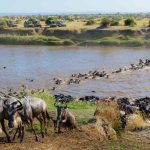
River crossings present a particular danger distinct from open-plains predation, with Nile crocodiles positioned along traditional crossing points representing one of the single greatest immediate threats a migrating zebra will face across the entire journey. Zebra behavior at crossing points often reflects genuine, visible hesitation, herds pacing along the riverbank for extended periods before committing to a crossing attempt, a hesitation that reflects real, evolutionarily reinforced risk assessment given how effectively crocodiles have learned to concentrate around these predictable, seasonally recurring bottlenecks in the zebra and wildebeest migratory route.
Foaling and the Timing of New Life on the Move
Zebra mares typically give birth to a single foal after an eleven to thirteen month gestation, and foaling activity within migrating herds tends to concentrate during periods of relatively higher grass availability, allowing mares to meet the substantial energy demands of lactation while still keeping pace with the broader herd’s ongoing movement. Newborn foals are capable of standing and walking within roughly an hour of birth, a critical adaptation given that migrating herds cannot realistically pause extended periods for a single birth, and a foal’s unique stripe pattern, distinct enough that mothers can visually identify their own offspring within a large, visually similar herd, plays an important early role in maintaining the mother-foal bond during the disorientating early days of a foal’s mobile, herd-based life.
Learning the Route Across Generations
Zebra migratory knowledge appears to be substantially learned rather than purely instinctive, passed down through generations as young zebras accompany their mothers along the same general routes repeatedly across multiple migratory cycles, gradually internalizing the timing, water sources, and danger points that define a successful annual circuit. This generational knowledge transfer underscores why maintaining unbroken migratory corridors matters so profoundly for the species’ long-term behavioral continuity, since a population forced to abandon a traditional route due to fencing or development does not simply relearn an equally effective alternative overnight but instead loses accumulated migratory knowledge that took many prior generations to establish.
Following the Zebra Migration Across the Ecosystem
Zebra migration routes broadly track the same rainfall-driven pattern that governs the wider Serengeti-Mara migration, moving between the southern Serengeti’s short-grass plains during the wet season calving period and the Mara ecosystem’s more reliable dry-season water sources, a broader migratory logic driven primarily by the search for fresh grass growth and reliable water across the ecosystem’s shifting rainfall patterns. Our destination overview of the Serengeti National Park covers the wider ecosystem’s seasonal movement patterns in more general detail, while our comparison of the Serengeti and Maasai Mara for migration viewing helps travelers plan specifically around the migration’s shifting geography throughout the year.
Conservation Considerations for a Species Often Overlooked
While plains zebras remain classified as Near Threatened rather than facing the acute crisis confronting some of East Africa’s more critically endangered species, the migration itself depends entirely on maintaining unobstructed movement corridors across an enormous, largely unfenced landscape spanning international borders between Kenya and Tanzania. Agricultural expansion, fencing, and infrastructure development along the migration’s traditional routes pose a genuine long-term threat to the free movement this entire grazing succession system depends on, since disrupting zebra migration timing would carry knock-on consequences for the wildebeest populations whose grazing patterns rely so heavily on the zebra’s preparatory role across the shared landscape.
For travelers witnessing the migration firsthand, taking a moment to specifically watch the zebra herds, rather than treating them purely as a visual accompaniment to the more famous wildebeest columns, reveals a considerably richer, more scientifically fascinating picture of how East Africa’s greatest wildlife spectacle actually functions as an integrated, interdependent ecological system rather than simply two species moving in loose, coincidental parallel across the same grassland. The stripes crossing the plains ahead of the main herd are, in their own quiet way, setting the table for everything and everyone that follows behind them.