More Than an Instinct: A Calculated Response to Rainfall
Over a million wildebeest moving in an unbroken column across the Serengeti-Mara ecosystem, their combined hoofbeats audible long before the herd itself comes into view, ranks among the most iconic wildlife spectacles on Earth, yet the underlying question of exactly why this migration happens, what actually drives such an enormous population to undertake a punishing, predator-filled circuit spanning hundreds of kilometers every single year, is considerably more scientifically interesting, and considerably more precisely understood by researchers, than the simple explanation of “instinct” most visitors leave with. Decades of ecological research have revealed the wildebeest migration to be a remarkably precise response to rainfall patterns, grass chemistry, and predator avoidance strategy operating simultaneously across an enormous, interconnected ecosystem, a set of overlapping pressures that together explain almost every major decision the herd makes across the full annual cycle.
Following the Rain, Not a Fixed Route
The circuit typically covers a distance of roughly 800 kilometers over the course of a full year, though the exact figure varies considerably depending on how erratically rainfall has fallen in any given season.
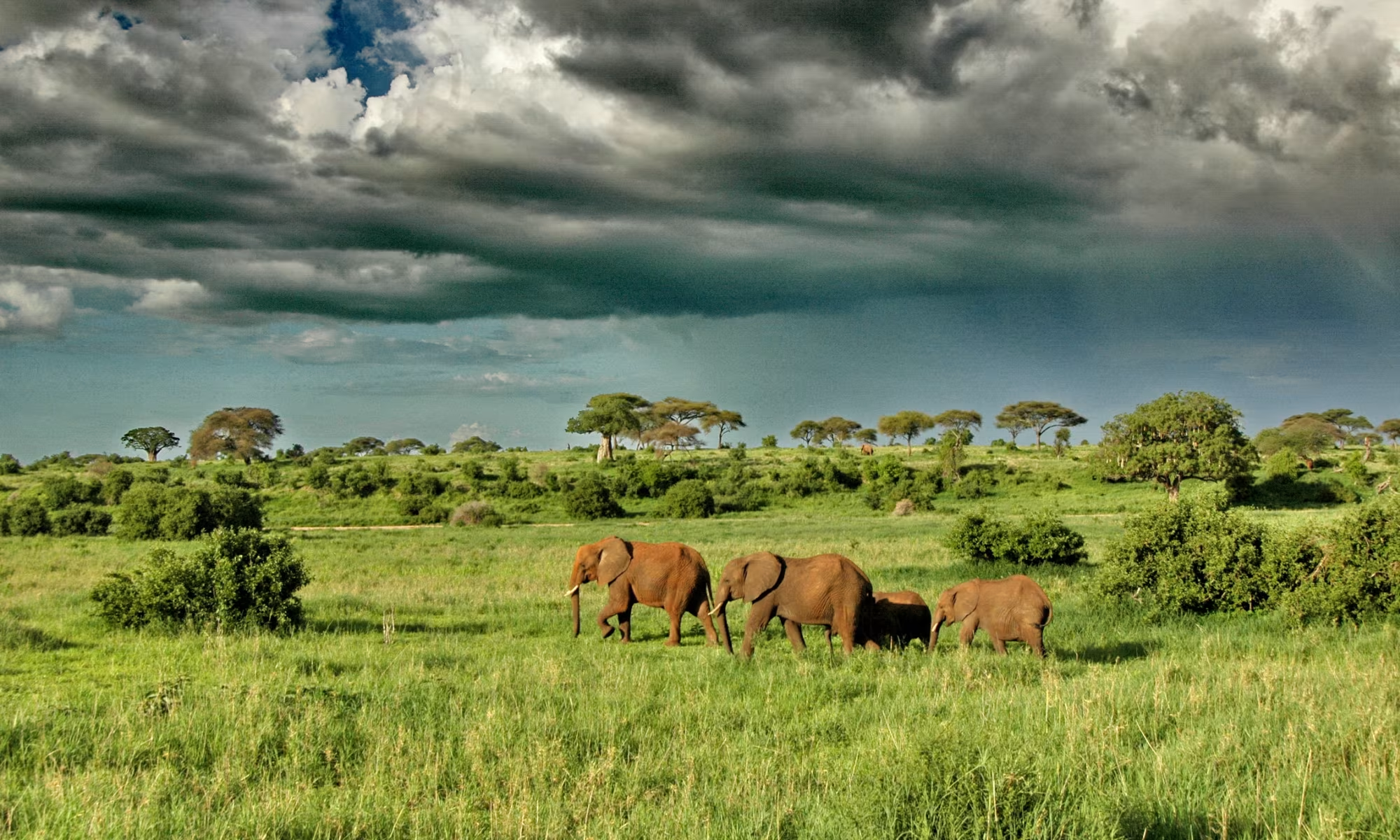
Contrary to popular assumption, the wildebeest migration does not follow a fixed, predetermined path repeated identically each year. Instead, the herds respond dynamically to actual rainfall patterns across the Serengeti-Mara ecosystem, meaning the specific timing and exact route of the migration shift somewhat from year to year depending on where and when rain has actually fallen. This rainfall-tracking behavior makes evolutionary sense given that fresh grass growth follows rainfall by only a matter of days, meaning wildebeest herds that successfully anticipate or quickly respond to rain gain access to the most nutritious, recently sprouted grass available anywhere in the ecosystem at that moment, a considerable advantage over herds that arrive too early, before growth has begun, or too late, after grazing pressure and natural maturation have reduced the grass’s nutritional value.
Sensing Rain From a Distance
Researchers believe wildebeest may detect distant rainfall through a combination of visual cues, including the sight of distant storm clouds and lightning, and possibly through scent, detecting the distinctive smell of rain-dampened earth carried on the wind from considerable distances. While the precise sensory mechanism remains an active area of scientific investigation, the practical result is unmistakable: wildebeest herds are frequently observed beginning movement toward a specific area before rain has even reached the herd’s current location, a genuinely impressive predictive capability that keeps the migration synchronized with the ecosystem’s constantly shifting rainfall patterns throughout the year.
The Nutritional Chemistry Behind the Movement
Beyond simple grass availability, the specific nutritional and mineral content of grass across different parts of the ecosystem plays a genuinely significant role in shaping migration timing, particularly around the southern Serengeti’s short-grass plains, where volcanic soil deposits from the nearby Ngorongoro highlands produce unusually phosphorus and calcium-rich grass growth during the wet season. This mineral-rich grazing is specifically critical during the calving season, when pregnant and lactating females require considerably elevated mineral intake to support both a developing calf and the substantial milk production that follows birth, making the southern plains’ specific soil chemistry a genuinely essential, rather than merely convenient, seasonal destination within the broader migratory circuit.
Synchronized Calving as a Survival Strategy
An estimated 80 percent of the migration’s roughly 500,000 annual calves are born within a remarkably tight window of just a few weeks each year, timed specifically to coincide with peak grass availability on the southern plains. This extreme birth synchronization functions as a genuine predator-swarming strategy, overwhelming the capacity of resident lions, hyenas, and other predators to consume more than a small fraction of the available calves during this brief window, a mathematical approach to calf survival that mirrors similar synchronized reproductive strategies documented across numerous other prey species facing intense, predictable predation pressure.
Water as the Other Half of the Equation
While fresh grass growth pulls herds toward recently rained-on areas, the search for reliable water becomes an equally decisive factor as the dry season progresses and temporary water sources across the southern and central Serengeti gradually disappear. This dual pressure, chasing fresh grass while simultaneously requiring consistent water access, is precisely what pushes the migration northward toward the Mara River and the more reliable water sources of the northern ecosystem each year, a movement that forces herds through the migration’s most dangerous and famous obstacle, the crossing of crocodile-infested river channels that claim a meaningful, if proportionally small, number of animals during each crossing attempt.
A Migration Nearly Lost to Disease
The modern wildebeest migration, often assumed to be an unbroken, ancient constant, actually recovered from a genuinely severe historical disruption during the twentieth century, when an introduced cattle disease called rinderpest swept through East Africa’s wildlife populations, decimating wildebeest numbers along with buffalo and other susceptible species across the region. Following a sustained cattle vaccination campaign that eventually eliminated rinderpest from the ecosystem by the 1960s, wildebeest numbers rebounded dramatically, eventually multiplying several times over from their disease-suppressed low and reestablishing the large-scale migratory pattern now considered so fundamentally characteristic of the Serengeti-Mara ecosystem. This historical recovery offers a genuinely instructive case study in ecological resilience, demonstrating that the migration, while sensitive to disruption, has shown real capacity to rebound once the specific pressure suppressing it was successfully addressed.
Why the Whole Ecosystem Depends on This Movement
The wildebeest migration functions as a genuine ecological engine driving the health of the entire Serengeti-Mara system, with grazing pressure stimulating fresh grass regrowth, dung deposits cycling nutrients back into the soil across an enormous area, and the sheer biomass moving through the ecosystem sustaining predator populations at a scale that would be entirely impossible without this concentrated, seasonal abundance. Our companion guide to zebra migration patterns across the same ecosystem explores how zebra grazing behavior actually helps prepare grazing land ahead of the main wildebeest columns, a genuinely interconnected piece of the same broader seasonal movement covered here from the wildebeest’s specific perspective.
The Genetics and Physiology of an Endurance Migrant
Blue wildebeest possess several physiological adaptations that make sustained, long-distance migration possible in the first place, including an efficient cardiovascular system capable of supporting extended periods of steady movement and a digestive system tuned toward rapidly processing the short, nutrient-dense grass characteristic of recently rained-on plains rather than the tougher, more fibrous vegetation favored by species specialized for browsing. Wildebeest also display a genuinely elevated tolerance for the physical stress of the migration’s most demanding stretches, including extended periods of reduced water intake during river crossing approaches and the sustained exertion required to maintain herd cohesion across open terrain while remaining alert to constant predation risk from trailing lions and hyenas.
Herd Size as a Mathematical Defense
The migration’s sheer scale, often exceeding a million individual wildebeest moving as a broadly coordinated mass, functions as a genuine mathematical defense strategy against predation, a principle ecologists describe as predator dilution. An individual animal’s statistical risk of being the specific target singled out by a hunting predator decreases considerably as herd size increases, meaning the migration’s enormous scale is not simply an incidental byproduct of a large regional population but an active survival strategy in its own right, one that smaller, more fragmented wildebeest populations elsewhere in Africa, lacking access to a comparably vast, unbroken migratory circuit, are simply unable to replicate at anything close to the same protective scale.
Climate Change and an Uncertain Future for the Pattern
Because the migration is so precisely tuned to historical rainfall patterns, shifting climate conditions across East Africa pose a genuine long-term concern for the system’s continued reliability. Increasingly erratic or unpredictable rainfall, a pattern climate scientists have documented with growing frequency across the region, has the potential to disrupt the tight synchronization between grass growth, calving timing, and herd movement that the entire migration depends on, a risk conservation researchers are actively monitoring given how much of the wider Serengeti-Mara ecosystem’s health depends on this predictable annual cycle continuing to function as it has for many thousands of years. Detailed research on migration dynamics and ongoing conservation monitoring is available through the IUCN Red List assessment of the blue wildebeest, which documents the species’ status across its East and Southern African range.
For safari travelers witnessing even a single stage of this extraordinary journey, understanding the scientific logic driving it, the chase for rain, the pursuit of mineral-rich grass, the water-driven push northward, transforms what might otherwise register simply as an overwhelming spectacle of numbers into a genuinely comprehensible, almost elegantly calculated survival strategy, refined across countless generations into one of the most efficient large-mammal movements anywhere on Earth. Every dust-choked column crossing the plains is, in its own way, a running calculation of rainfall, mineral content, water security, and predator math, continuously updated in real time by an animal most visitors underestimate entirely until they see the sheer scale of what that calculation produces stretched across the horizon, dust rising, hooves drumming, a whole ecosystem’s logic made suddenly, thunderously visible.