
Lalibela’s Rock-Hewn Churches: A Visitor’s Guide
The Lalibela rock churches rank among the most remarkable religious monuments anywhere on earth, eleven medieval churches carved downward directly out of solid volcanic rock rather than built up from a foundation the way almost every other church on the planet is constructed. Still an active pilgrimage site today, nearly eight centuries after their construction, Lalibela offers travelers a rare combination of architectural wonder and genuinely living faith, worshippers still gather here daily, not a preserved relic behind glass. This guide covers the history, the individual churches worth prioritizing, and the practical details of planning a visit.
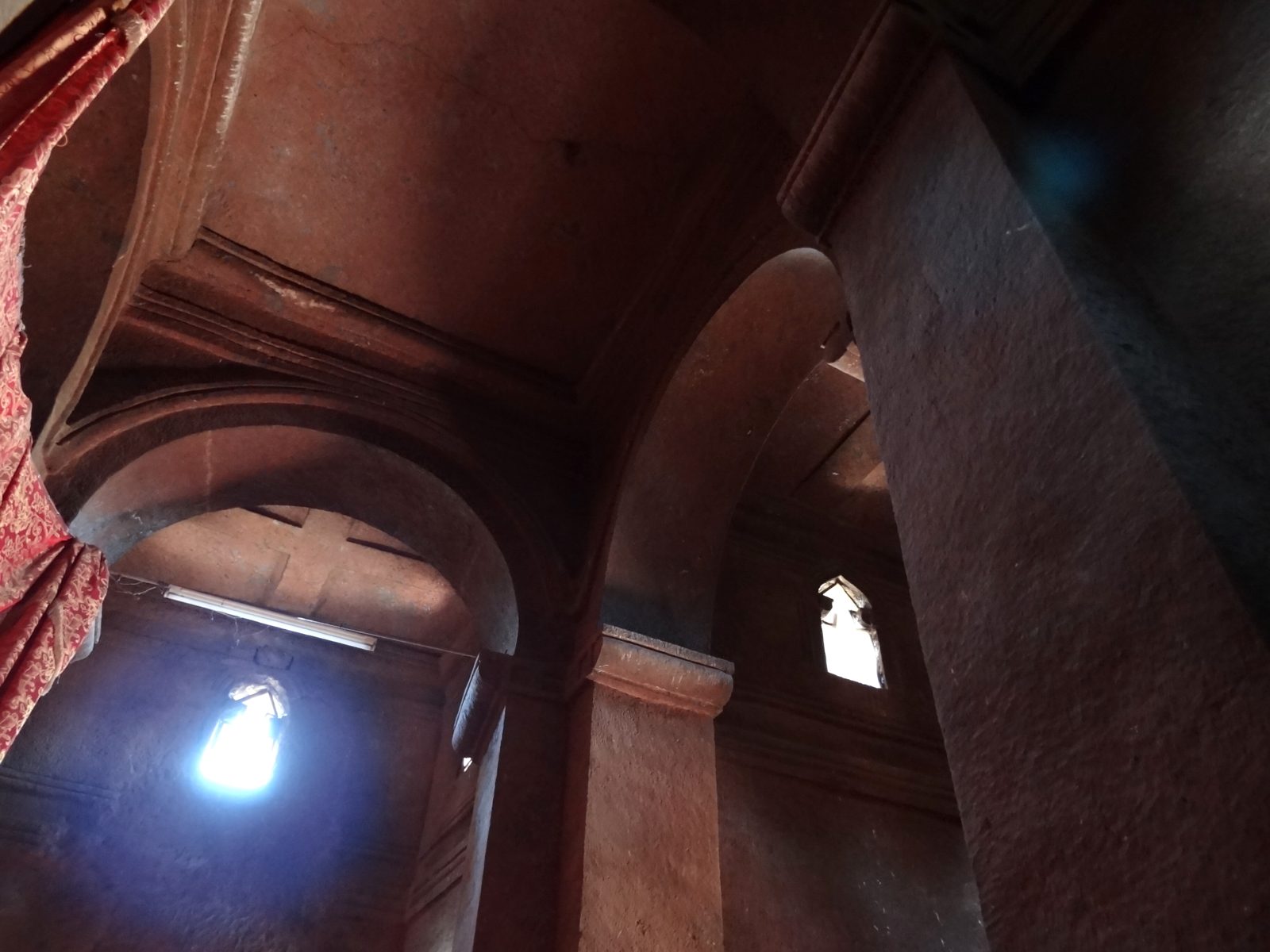
Interior arches of Bet Giyorgis rock-hewn church, Lalibela, Ethiopia. Photo: Adam Jones, CC BY-SA 2.0, via Wikimedia Commons.
The History Behind Lalibela
According to tradition, King Gebre Meskel Lalibela of Ethiopia’s Zagwe dynasty commissioned the churches in the late twelfth or early thirteenth century, intending to create a new Jerusalem in the Ethiopian highlands after political upheaval made pilgrimage to the actual Holy Land increasingly difficult for Ethiopian Christians. The town itself, originally called Roha, was later renamed Lalibela in the king’s honor, and several features throughout the site, a river named the Jordan, a hill called Mount Tabor, deliberately echo the geography of Jerusalem, reinforcing the site’s role as a symbolic holy city rather than a mere architectural showcase.
How the Churches Were Actually Carved
Each of the eleven churches was carved from the top down, workers first cutting a deep trench around a single block of volcanic rock, then hollowing out windows, doors, and interior chambers from that isolated stone monolith, leaving the surrounding rock as the church’s exterior walls, floor, and roof all in one continuous piece. This monolithic construction technique required extraordinary planning, since any mistake couldn’t simply be patched over the way a built structure might allow, and the result is a set of buildings that are, in the truest sense, sculpted rather than constructed. Historians still debate exactly how long the full project took and how large the workforce was, though local tradition credits both human labor and, in devout retellings, angelic assistance.
Bet Giyorgis: The Church of St. George
Bet Giyorgis, carved in the shape of a perfect Greek cross when viewed from above, stands as Lalibela’s most photographed and arguably most beautiful church, set apart from the other ten in its own excavated pit connected by a narrow trench. Local tradition holds that King Lalibela built this church last, after Saint George himself appeared and asked why no church had been dedicated to him, and the story adds a layer of legend to what is already an extraordinary feat of engineering. Visiting at different times of day changes the experience considerably, since the angle of sunlight into the deep-cut trench surrounding the church shifts dramatically from morning to afternoon.
The Northern and Southern Church Clusters
Beyond Bet Giyorgis, the remaining ten churches split into two main clusters connected by tunnels and trenches that visitors can walk through as part of the full experience. The northern group includes Bet Medhane Alem, believed to be the largest monolithic rock-hewn church in the world, along with Bet Maryam, richly decorated with carved crosses, geometric patterns, and painted ceiling frescoes that have survived centuries. The southern cluster includes Bet Emanuel, noted for its precise, almost building-like exterior detailing, and Bet Gabriel-Rufael, thought by some scholars to have originally served a different, possibly royal, purpose before being adapted into a church.
Walking the Tunnels Between Churches
Part of what makes visiting Lalibela so immersive is the network of trenches and tunnels connecting many of the churches, some open to the sky, others fully enclosed and pitch dark, requiring visitors to feel their way along carved walls. One tunnel in particular, representing a symbolic journey through hell before emerging into the light near a church representing heaven, adds a genuinely spiritual dimension to what might otherwise be simply an architectural tour. Comfortable, sturdy footwear matters here, since the stone surfaces are uneven and can be slick, particularly after rain.
Witnessing Living Worship
Lalibela remains an active center of Ethiopian Orthodox Christian worship, and visitors arriving early in the morning often encounter white-robed pilgrims and priests conducting prayers and ceremonies exactly as they have for generations. This living dimension sets Lalibela apart from many historical sites that have been effectively musealized; here, the churches are still doing the job they were built for. Visitors should dress and behave respectfully throughout, since this is an active religious site rather than a purely secular tourist attraction, and photography inside active services is worth confirming with a guide or local authority before assuming it’s appropriate.
When to Visit Lalibela
The dry season, roughly October through May, offers the most comfortable conditions for exploring the site’s uneven stone surfaces and open trenches, while the June-through-September wet season brings heavier rain that can make some areas slippery or temporarily inaccessible. Timkat, Ethiopia’s Orthodox celebration of Epiphany in January, transforms Lalibela into an extraordinary spectacle of pilgrimage and ceremony, drawing enormous crowds of worshippers, a powerful experience for travelers able to time a visit around it, though it also means considerably higher demand for accommodation and guides during that specific window, so booking well ahead of a Timkat visit is essential rather than optional.
Planning Your Visit
Most visitors need a full day, and ideally two, to properly explore all eleven churches along with the connecting tunnels and trenches, and a knowledgeable local guide adds substantial value here, since much of the symbolism and history behind individual carvings and layouts isn’t obvious without context. Lalibela is reachable by domestic flight from Addis Ababa, landing at a small airport not far from the town center, making it an accessible add-on even for travelers without extensive time to spend on Ethiopia’s rougher overland routes.
What to Wear and Etiquette to Follow
Because the churches remain active places of worship, modest dress matters throughout a Lalibela visit, covered shoulders and knees for both men and women, and a headscarf is worth carrying for women wishing to enter certain areas where covering the head is expected. Visitors remove their shoes before entering most of the churches, so easily removable footwear saves considerable hassle across a day spent moving between eleven separate buildings. Speaking quietly, avoiding pointing at religious icons or artwork, and asking permission before photographing priests or worshippers directly are all small courtesies that go a long way in a place that, despite its fame as a tourist destination, remains first and foremost a place of genuine religious significance to the people who worship there.
Photography Tips for the Churches
Low light inside many of the churches makes photography genuinely challenging, and a camera capable of handling higher ISO settings without excessive noise helps considerably more than relying on flash, which is often restricted or discouraged inside active worship spaces. Bet Giyorgis photographs best from the elevated rim of its surrounding trench, giving the classic aerial view of its cross shape, and arriving early in the morning both avoids the largest crowds and catches softer, more directional light across the reddish volcanic stone. A wide-angle lens serves the tighter interior spaces and connecting tunnels well, where a standard lens often can’t capture the full scale of a chamber from a comfortable distance.
Where to Stay in Lalibela
Lalibela’s accommodation scene has grown considerably as tourism to the site has increased, ranging from simple guesthouses within walking distance of the churches to a handful of more comfortable hotels offering sweeping views over the surrounding highlands. Staying close to the church complex itself makes early morning visits, when both the light and the atmosphere of active worship are at their best, considerably more convenient than a longer transfer from accommodation further out. Booking ahead matters particularly around Timkat and other major religious festivals, when the town’s limited room inventory fills quickly with both pilgrims and tourists.
Combining Lalibela With a Wider Ethiopia Trip
Lalibela typically anchors the historical northern circuit of an Ethiopia itinerary, often paired with Gondar’s castles and the Simien Mountains for travelers with a week or more to dedicate specifically to Ethiopia’s north. Travelers building out a full Ethiopia travel guide itinerary should treat Lalibela as one of the non-negotiable highlights, alongside the Simien Mountains for trekking and, for those with additional time, the more remote Omo Valley or Danakil Depression further afield. However you sequence it, giving Lalibela the full day or two it deserves, rather than rushing through as a quick stopover, is what separates a memorable visit from a merely checked-off landmark.
Recommended Tours: 9 Days Uganda Gorilla Safaris & Jinja Nile Cultural Experience | 7 Days Classic Rwanda Safari