

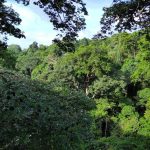
Most visitors picture Uganda as rolling savannah and misted volcanoes, which is exactly why Semuliki National Park catches people off guard. Tucked into the far west of the country against the border with the Democratic Republic of Congo, this is the only place in East Africa where the true lowland rainforest of the Congo Basin pushes across a border and keeps going. The result is a park that looks and sounds like nowhere else on a Uganda safari circuit: steaming volcanic springs, a soundtrack of hornbills instead of lions, and a species list that reads like it belongs to Central Africa rather than the Rift Valley.
Semuliki National Park: Uganda’s Only True Lowland Rainforest
Semuliki National Park covers roughly 220 square kilometres in Bundibugyo District, sitting at a low, humid elevation of 670 to 760 metres above sea level, which is part of why the vegetation and wildlife feel so different from the highland parks further east. The forest here started life as a forest reserve back in 1932, protected mainly for its timber value, before the government upgraded it to full national park status in 1993 in recognition of just how unusual and biologically rich the area is. What makes it scientifically significant is its position: Semuliki is the eastern-most extension of the great Ituri Forest that spreads across the Congo Basin, meaning the plants and animals here have more in common with Central Africa’s rainforest belt than with the acacia country most safari-goers associate with Uganda.
Where the Rift Valley Meets the Congo Basin
Geographically, the park is boxed in by two dramatic landmarks. To the south rise the snow-capped Rwenzori Mountains, and to the north the forest gives way to the shores of Lake Albert, with the Semuliki River itself forming the international boundary with DR Congo along the park’s western edge. That combination of a young rift valley floor, an ancient river system, and equatorial rainforest is what produces the park’s strangest feature: active geothermal activity bubbling up through the forest floor at a place called Sempaya.
The Sempaya Hot Springs
Sempaya is the reason most travellers make the detour to Semuliki in the first place. The two hot springs here, known locally as the male and female springs, sit within a swampy clearing reached on a guided walk from the Sempaya visitor office, and the contrast between them is part of what makes the visit memorable rather than just another roadside curiosity.
Bintente, the Male Spring
The outer spring, called Bintente, is roughly 12 metres across and altogether calmer than its counterpart, forming a wide, steaming pool in a clearing that guides can walk you right up to. Getting there takes about an hour along a forest trail where red-tailed monkeys, grey-cheeked mangabeys, and black-and-white colobus move through the canopy overhead, so the walk itself is as much a wildlife encounter as the destination.
Nyasimbi, the Female Spring
A separate 30-minute walk through a stand of raffia palm leads to Nyasimbi, the inner spring, which behaves nothing like Bintente. This one is a genuine geyser, its water reaching around 103 degrees Celsius and periodically spurting boiling water and steam roughly two metres into the air. Local Bamaga clan elders still travel to Nyasimbi each year to perform rituals honouring their ancestors, a practice the Uganda Wildlife Authority formally permits, which adds a layer of living cultural meaning to what would otherwise be a purely geological sight. Entry to the springs costs 35 US dollars for foreign non-residents, 25 dollars for foreign residents, and 15,000 Ugandan shillings for East African citizens, on top of the standard park entrance fee.
A Forest Full of Primates and Rare Birds
Because Semuliki National Park sits at the edge of the Congo Basin rather than in it, it hosts a mix of wildlife found nowhere else on the standard Uganda itinerary, and the park’s two flagship activities beyond the springs are built entirely around that fact.
Eight Primate Species Along the Red Monkey Track
The park protects eight primate species, and the best way to see most of them is the 11-kilometre Red Monkey Track that traces Semuliki’s eastern boundary. This trail is the most reliable place in Uganda to see the De Brazza’s monkey, a striking animal with a white beard and orange brow that barely ranges beyond Central Africa, alongside Dent’s mona monkeys, olive baboons, and further troops of red-tailed monkeys and mangabeys. Sightings take patience, since the forest canopy here is thick and the animals keep to the mid and upper storeys, but guides who walk this track daily know the fruiting trees and calling patterns well enough to put visitors in the right spot at the right time.
More Than 400 Birds in the Canopy
Birders tend to rate Semuliki among the best single sites in Uganda, and the numbers back that up: over 400 species have been recorded here, a substantial share of them Guinea-Congo forest specialists that simply do not occur in the country’s other parks. Sempaya and the nearby Ntandi trading centre are the two standout viewing points, where patient watchers regularly pick out the white-crested hornbill, the diminutive red-billed dwarf hornbill, piping hornbills moving in noisy groups, the yellow-throated nicator, and both great blue and Ross’s turacos flashing through the canopy. For a serious birder building an East Africa list, a morning at Sempaya can add a dozen or more species unavailable anywhere else on a Uganda trip.
Life Around the Park: The Batwa of Ntandi
Semuliki’s story is not only ecological. The Batwa, often referred to as forest pygmies, lived inside this rainforest for generations, relying on it for food, shelter, and medicinal plants long before conservation boundaries existed. When the area was gazetted for protection, the Batwa were resettled outside the park, a history that mirrors what happened to Batwa communities around Bwindi and Mgahinga further south. Rather than leaving that history untold, the Uganda Wildlife Authority now works with the community at Nabisoli, near the park headquarters at Ntandi, where the Batwa run the Boma Cultural Village as a source of income built directly on their traditional knowledge.
A visit there typically includes fire-making by friction, demonstrations of the herbal medicine the Batwa once relied on for every ailment, traditional hunting and archery techniques, and music and dance performed with the same energy that once accompanied life inside the forest. It is a short stop compared with the hot springs walk or a full day on the Red Monkey Track, but it rounds out a visit to Semuliki National Park with context that the wildlife alone cannot provide.
Planning a Visit to Semuliki National Park
Because Semuliki sits further off the main safari circuit than parks like Queen Elizabeth or Kibale, a little planning goes a long way toward making the detour worthwhile.
Getting There
Fort Portal is the natural gateway to the park and the usual overnight base for anyone heading this way. From Fort Portal it is about 52 kilometres, roughly a two-hour drive, along the Fort Portal-Bundibugyo road, which climbs briefly over the Rwenzori foothills before dropping into the lowland forest. Reaching Fort Portal itself from Kampala takes somewhere in the region of five to six hours by road via Mubende, which is why most visitors combine Semuliki with time in Kibale Forest or the Rwenzori Mountains rather than treating it as a standalone trip. Charter flights into Semuliki’s small airstrip are possible for those short on time, though operators generally need a minimum number of passengers to make a flight viable.
Entrance Fees and Permits
Standard park entrance for Semuliki follows the same tiered structure as the hot springs fee described above, with foreign non-residents paying more than foreign residents, and East African citizens paying a shilling-denominated rate that is considerably lower than either. Because government-set park fees are revised periodically, it is worth confirming the current figure directly with a tour operator or the Uganda Wildlife Authority before finalising a budget.
Best Time to Go
The two dry spells, roughly December through February and June through August, offer the easiest walking conditions on both the hot springs trail and the Red Monkey Track, since the paths dry out and river crossings become more manageable. Visiting in the wetter months is not a reason to skip the park, though; the forest floods in places during heavy rain, giving the landscape an almost prehistoric look that photographers in particular tend to find worth the extra mud.
Where to Stay
Options near the park remain modest compared with the lodges around Uganda’s bigger-name parks, which suits Semuliki’s low-key character. Bumaga Camp, run by the Uganda Wildlife Authority close to Sempaya, offers simple budget accommodation within easy reach of both springs. Semuliki Safari Lodge and Ntoroko Game Lodge provide more comfortable mid-range options within driving distance, while travellers who prefer a proper bed and hot water after a day in the forest often base themselves in Fort Portal instead and treat Semuliki as a full-day excursion.
Why Semuliki National Park Belongs on Your Uganda Itinerary
Semuliki National Park rewards travellers precisely because it refuses to repeat what the rest of Uganda already does well. There are no lions here, no wide savannah views, and no crowds of vehicles jostling for a sighting. What there is instead is a rare, self-contained slice of the Congo Basin, a geyser that has been erupting long before anyone thought to build a trail to it, and a community whose history is woven into the landscape as tightly as the raffia palms along the path to Nyasimbi. For anyone who has already ticked off gorilla trekking in Uganda’s better-known parks and wants to see a genuinely different side of the country, Semuliki is one of the few places left that still feels like a discovery. Readers planning a broader route through the country’s parks may also find our guide to Uganda’s national parks ranked for a first-time visitor useful for working out where Semuliki fits alongside the rest of the itinerary, and the park’s own Semuliki National Park destination page has details on tailoring a visit to your dates. For further background on the park’s conservation status and official activities, the Uganda Wildlife Authority’s Semuliki page is a reliable primary source.













