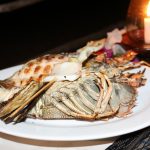
Swahili cooking is the product of a thousand years of Indian Ocean trade, condensed onto a single plate. Spices from India and Arabia, cooking techniques carried by Portuguese and Omani traders, and the coconut palms that grow abundantly along the entire coastline all fold into a cuisine that tastes distinct from anything found inland, yet varies in its own subtle ways between Zanzibar’s kitchens and Mombasa’s. Tracing that cuisine across both cities makes for one of the more rewarding food trails available anywhere on the East African coast.
Pilau: The Everyday Celebration Dish
No Swahili meal represents the coast’s spice-trading history quite as directly as pilau, an aromatic rice dish built on a base of cardamom, cloves, cinnamon, and cumin, slow-cooked with beef, chicken, or fish until the rice fully absorbs the spiced stock it’s cooked in. Rice gets toasted in ghee before the whole spices go in, a technique that deepens the dish’s aroma considerably compared with simply boiling rice and adding spice afterward, and the result is a dish fragrant enough to announce itself well before it reaches the table.
Pilau holds a particular place in Swahili coastal life as the default dish for celebrations, weddings, and significant family gatherings, prepared in large quantities and shared communally rather than treated as an everyday meal in most households. Travellers are as likely to encounter genuinely excellent pilau at a small family-run restaurant in Zanzibar’s Stone Town as at a more formal establishment in Mombasa, since the dish’s quality depends far more on a cook’s skill with spice balance than on the formality of the setting.
Biryani: The More Elaborate Cousin
Where pilau represents everyday Swahili celebration cooking, biryani reflects the coast’s deeper Indian trading connections more directly, prepared with considerably more technical complexity. Traditional biryani is built in two separate components: a pot of saffron-coloured, richly aromatic rice, and a separate rich meat curry, layered together only at the final stage of cooking rather than combined from the start as with pilau. The result carries a more complex, layered flavour profile than pilau, and it’s generally considered the more elaborate, showstopping dish of the two, reserved for occasions calling for something a step beyond the everyday celebratory meal.
Mahamri and the Coconut’s Central Role
Coconut runs through nearly every corner of Swahili cooking, and nowhere more visibly than in mahamri, small fried bread rounds made with coconut milk and yeast that leaven into a distinctively hollow, fluffy texture unlike standard fried dough found elsewhere in the region. Cardamom gives mahamri its characteristic aroma, and the golden, slightly crisp exterior gives way to a soft, faintly sweet interior that pairs naturally with spiced tea, making it a fixture of breakfast tables and street food stalls alike across both Zanzibar and Mombasa.
Coconut’s reach extends well beyond mahamri. Coconut milk forms the base for countless coastal curries, coconut oil is a common cooking fat throughout the region, and dishes like ndizi za nazi, bananas simmered gently in coconut milk, showcase how central the palm is to Swahili cooking beyond its more obvious uses. Smaller coconut-based sweets and biscuits, sold from stalls and small bakeries throughout Stone Town and Mombasa’s Old Town, round out a food culture in which coconut functions almost as a base ingredient in its own right rather than a single flavouring among many.
Mishkaki: Grilled Skewers on Every Corner
Mishkaki, marinated and grilled meat skewers cooked over open charcoal, are as close to a universal Swahili street food as exists on the coast, sold from small stalls in Stone Town’s Forodhani Gardens night market and along Mombasa’s Old Town streets alike. Beef is the most common base, though chicken and goat versions are widely available too, marinated in a blend that typically includes garlic, ginger, and a mix of local spices before hitting the grill. Eaten straight off the skewer, often with a simple side of kachumbari, a fresh tomato and onion salad, mishkaki offers one of the most accessible entry points into Swahili flavour for travellers not ready to commit to a full sit-down meal.
Regional Differences Between Zanzibar and Mombasa
While the two cities share a common Swahili culinary foundation, subtle differences separate a Zanzibar kitchen from a Mombasa one. Zanzibar’s cooking leans slightly more heavily on the island’s own spice production, with cloves, nutmeg, and vanilla, all grown locally, finding their way into dishes with a directness that mainland cooking doesn’t quite replicate given that Mombasa’s spices largely arrive through trade rather than local cultivation. Zanzibar’s seafood-forward dishes, unsurprisingly, also tend to draw on a slightly different catch than Mombasa’s, reflecting the specific reef and channel fishing grounds surrounding the island.
Mombasa’s food scene, meanwhile, carries a somewhat stronger Indian influence, a legacy of the significant Indian merchant community that settled in the city during its trading heyday, which shows up in the city’s particularly strong biryani tradition and its wider availability of bhajia, spiced and battered potato fritters that function as both street snack and side dish across Old Town. Travellers moving between the two cities on the same trip often notice this shift most clearly in how dishes are spiced: Mombasa’s food frequently carries a sharper, more distinctly Indian-inflected heat, while Zanzibar’s leans toward the warmer, more rounded spice notes associated with its own clove and cardamom production.
Where to Eat in Each City
In Zanzibar, Stone Town’s Forodhani Gardens night market remains the essential starting point for sampling Swahili street food in one concentrated setting, our dedicated guide to that market covers the full range of what’s on offer there each evening. Beyond Forodhani, small family-run restaurants throughout the old town, often unmarked beyond a simple sign, frequently serve the most authentic pilau and biryani on the island, generally at a fraction of the price charged by restaurants explicitly catering to tourists.
In Mombasa, Old Town’s narrow streets hold a comparable concentration of small eateries, particularly around the area near Fort Jesus and the main market, serving biryani, mishkaki, and mahamri from stalls that have often operated in the same spot for generations. Our walking guide to Mombasa’s Old Town covers this same stretch of streets from a historical and architectural angle, making it easy to combine a heritage walk with a food-focused afternoon in the same neighbourhood.
Drinks That Complete the Meal
Swahili coastal cuisine isn’t complete without its drinks, and a proper food trail should give as much attention to what fills the cup as what fills the plate. Kahawa, spiced coffee brewed strong and often flavoured with cardamom, is sold from small stalls and carried through the streets by vendors balancing brass coffee pots on charcoal warmers, served in tiny cups alongside a handful of roasted peanuts or spiced cashews rather than any accompanying pastry. It’s less a drink to linger over than a quick, ritualised pause built into the rhythm of a working day, and watching a kahawa vendor work a busy street corner is its own small piece of coastal culture worth seeing.
Fresh tamarind juice, tangy and refreshing in the coastal heat, and ginger-spiced tea known locally as chai ya tangawizi both appear regularly alongside meals, offering a counterpoint to the richer coconut-based dishes that dominate much of the menu. Freshly pressed sugarcane juice, ground through hand-cranked presses at market stalls, rounds out the drink options found throughout both cities, a simple, naturally sweet refreshment that pairs particularly well with the heavier spiced dishes that define much of Swahili cooking.
Building a Two-City Food Trail
Travellers with time to explore both cities get the fullest picture of Swahili coastal cuisine by treating the trip as a genuine comparison rather than sampling the same handful of dishes twice. Starting in one city and finishing in the other, with a deliberate effort to try the same core dishes, pilau, biryani, mahamri, and mishkaki, in both places offers a genuinely interesting way to taste how one cuisine has developed two distinct regional accents across a relatively short stretch of coastline. Pairing meals with a spice tour in Zanzibar or a market walk in Mombasa’s Old Town adds useful context to what ends up on the plate, connecting the ingredients back to the trade routes and history that shaped this cuisine in the first place.
Whether the trip favours one city over the other or splits time evenly between both, following this particular food trail offers one of the more direct, sensory ways to understand just how deeply the Indian Ocean’s centuries of trade reshaped everyday life along the Swahili coast, one plate at a time.
Travellers pressed for time can still get a meaningful taste of this cuisine even without a dedicated multi-day food trail, simply by prioritising one proper sit-down meal of pilau or biryani in each city and grazing on mishkaki, mahamri, and a cup of kahawa wherever the opportunity arises. What matters most isn’t covering every dish on this list in a single visit, but approaching the coast’s food with the same curiosity most travellers already bring to its beaches, ruins, and markets.