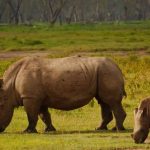
Black Rhino vs White Rhino: How to Tell Them Apart in the Field
Understanding the differences between black rhinos and white rhinos helps travellers identify these remarkable African mammals during wildlife safaris. Although both species have enormous bodies, thick skin and distinctive horns, they differ in size, mouth shape, feeding habits, behaviour and preferred habitats.
The most reliable way to distinguish a black rhino from a white rhino is by examining its mouth. Black rhinos have pointed, flexible upper lips adapted for browsing leaves and branches. White rhinos have broad, square-shaped mouths designed for grazing on grass.
These differences influence how the animals feed, move and interact with their surroundings. White rhinos are generally larger and often occupy open grasslands, while black rhinos prefer habitats containing shrubs and woodland.
Both species face serious conservation challenges, particularly illegal hunting for their horns and habitat fragmentation.
This guide explains the main differences between black and white rhinos, where to observe them in East Africa, and how to identify them safely during a safari.
Black Rhino vs White Rhino: Main Differences
Black rhinos and white rhinos are separate species belonging to the family Rhinocerotidae.
Despite their names, both animals generally have grey skin.
Their appearance can change depending on soil colour, mud and dust.
Quick Comparison Table
| Feature | Black Rhino | White Rhino |
|---|---|---|
| Scientific name | Diceros bicornis | Ceratotherium simum |
| Mouth shape | Pointed, flexible upper lip | Broad, square upper lip |
| Feeding habit | Browsing | Grazing |
| Body size | Generally smaller | Generally larger |
| Head position | Often held higher | Usually held lower |
| Preferred habitat | Bushland and woodland | Open grassland |
| Social behaviour | Mostly solitary | More sociable |
| Temperament | Often more reactive | Generally calmer |
| Horns | Usually two | Usually two |
These characteristics provide useful identification clues, although individual behaviour varies.
1. Mouth Shape: The Easiest Way to Identify Rhinos
The most dependable difference between black and white rhinos is their upper lip.
Each species has developed a mouth suited to its preferred diet.
Black Rhino: Pointed Upper Lip
Black rhinos possess a pointed, prehensile upper lip.
This flexible structure allows them to grasp leaves, twigs and branches.
During feeding, a black rhino may extend its upper lip towards vegetation and pull suitable material into its mouth.
This adaptation is particularly useful in habitats containing thorny shrubs.
White Rhino: Broad, Square Mouth
White rhinos have wide, relatively flat mouths adapted for grazing.
Their lips allow them to gather grass close to the ground.
While feeding, white rhinos commonly lower their heads and move slowly across suitable grassland.
Field identification tip: If the animal is clearly visible, examine its mouth before considering other characteristics.
2. Body Size and Physical Appearance
White rhinos are generally larger and heavier than black rhinos.
Adult southern white rhino males commonly weigh approximately 2,000–2,500 kilograms, although individual weights vary.
Black rhinos usually weigh around 800–1,400 kilograms.
How Their Bodies Differ
White rhinos have broad bodies, large heads and a pronounced muscular hump around the shoulders.
This hump helps support the weight of their heads during grazing.
Black rhinos generally have more compact bodies and less prominent shoulder humps.
Their heads are often carried higher when browsing.
Can You Identify Them by Colour?
No. Both species usually have grey skin.
Mud and dust can make individuals appear brown, reddish or almost black.
Consequently, colour is not a reliable identification feature.
3. Feeding Habits: Browsers vs Grazers
Feeding behaviour provides another useful way to distinguish the two species.
Black rhinos mainly browse vegetation, while white rhinos primarily graze.
What Do Black Rhinos Eat?
Black rhinos consume various plant materials, including:
-
Leaves.
-
Young shoots.
-
Woody shrubs.
-
Small branches.
-
Suitable thorny vegetation.
Their pointed lips help them select individual plant parts.
What Do White Rhinos Eat?
White rhinos mainly feed on grasses.
They spend considerable time moving through open areas while grazing.
Their broad mouths allow them to gather vegetation efficiently.
| Feeding Behaviour | Likely Species |
|---|---|
| Pulling leaves from shrubs | Black rhino |
| Grazing with head lowered | White rhino |
| Feeding among dense bushes | Black rhino |
| Eating short grass | White rhino |
Observing feeding behaviour can be particularly helpful when an animal’s face is partly hidden.
4. Head Position and Horn Appearance
Head posture often provides useful identification clues.
Black rhinos frequently hold their heads relatively high while inspecting vegetation.
White rhinos commonly keep their heads low because they spend much of their feeding time grazing.
Do Their Horns Look Different?
Both species normally have two horns.
The front horn is usually longer than the rear horn.
However, horn length and shape vary between individuals.
Age, genetics, wear and previous injuries influence horn appearance.
Some rhinos have shortened horns because of conservation management or natural damage.
Therefore, horn length alone should never determine identification.
5. Differences in Rhino Behaviour
Black and white rhinos display different social tendencies.
Black rhinos are generally solitary, although mothers remain with dependent calves.
Adult males may defend territories containing suitable resources.
Black Rhino Behaviour
Black rhinos can be highly reactive when surprised.
Their limited eyesight means they often rely on smell and hearing to investigate unfamiliar situations.
A disturbed black rhino may turn towards the source of a sound or move suddenly.
However, behaviour varies between individuals.
White Rhino Behaviour
White rhinos are generally more sociable.
Females, calves and younger animals may form small groups.
Adult males often maintain territories, particularly where suitable grazing is available.
White rhinos can also become aggressive when threatened.
Neither species should be approached casually.
6. Habitat Preferences and Distribution
Black rhinos occur in habitats containing suitable browsing vegetation.
These include bushland, woodland and mixed savannah.
White rhinos generally prefer open grassland with reliable grazing opportunities.
Where Do They Overlap?
Both species can occupy the same protected areas when suitable habitats are available.
However, they may use different sections according to vegetation and feeding requirements.
For example, a white rhino may graze across an open plain while a black rhino feeds among nearby shrubs.
Understanding these preferences can help safari guides locate each species.
7. Best Places to See Black Rhinos in East Africa
Black rhinos survive in several carefully protected East African conservation areas.
Ol Pejeta Conservancy, Kenya
Ol Pejeta is one of Kenya’s most important rhino conservation destinations.
The conservancy supports black rhinos alongside southern white rhinos.
Experienced guides provide opportunities to observe these animals while learning about conservation.
Ngorongoro Crater, Tanzania
The Ngorongoro Crater contains a small, closely monitored black rhino population.
Visitors occasionally encounter rhinos on the crater floor.
However, sightings remain unpredictable.
Kenya’s Other Rhino Areas
Black rhinos also occur in selected protected areas, including Lake Nakuru National Park and specialised rhino sanctuaries.
Wildlife viewing must follow conservation regulations.
8. Best Places to See White Rhinos in East Africa
White rhinos can be observed in several East African conservation areas.
Ziwa Rhino Sanctuary, Uganda
Ziwa Rhino Sanctuary is an important destination for observing southern white rhinos in Uganda.
The sanctuary has played a major role in restoring the country’s rhino population.
Visitors can participate in authorised guided rhino-tracking activities.
Lake Nakuru National Park, Kenya
Lake Nakuru supports both black and white rhinos.
Its grasslands provide suitable feeding areas for white rhinos.
The park also supports giraffes, buffaloes and numerous bird species.
Ol Pejeta Conservancy, Kenya
Ol Pejeta supports southern white rhinos and the world’s last two surviving northern white rhinos.
The northern white rhino is a subspecies of the white rhino.
Its remaining population consists of two females, meaning natural reproduction is no longer possible.
Conservation scientists continue working on assisted reproductive techniques.
9. Rhino Conservation in Uganda
Uganda’s native rhino populations disappeared from the wild during the twentieth century because of poaching and instability.
Rhino recovery efforts subsequently established breeding populations of southern white rhinos.
Ziwa Rhino Sanctuary became central to these programmes.
More recently, Uganda has undertaken further rhino translocations to protected areas, including Ajai Wildlife Reserve and Kidepo Valley National Park.
These activities aim to restore rhinos within suitable habitats while strengthening long-term conservation.
However, visitors should confirm current access arrangements before planning rhino-viewing activities.
10. Why Are Black and White Rhinos Threatened?
Both species face serious conservation pressures.
Illegal hunting for rhino horns remains a major threat.
Habitat loss and fragmentation can also limit population growth and movement.
Main Conservation Challenges
Important threats include:
-
Illegal wildlife hunting.
-
Habitat destruction.
-
Human settlement expansion.
-
Restricted wildlife movement.
-
Small, isolated populations.
-
Limited genetic diversity in some populations.
How Conservation Programmes Help
Protected areas use several approaches to safeguard rhinos.
These include ranger patrols, population monitoring, habitat management and carefully planned translocations.
Veterinary care and genetic research also support conservation programmes.
Responsible tourism can contribute financially to maintaining protected habitats.
11. How to Identify Rhinos During a Game Drive
When observing a rhino, begin with its mouth shape and feeding behaviour.
If the animal is too distant, examine its head posture, body shape and surrounding habitat.
Practical Identification Checklist
Black rhino:
-
Pointed upper lip.
-
Usually smaller body.
-
Often browsing shrubs.
-
Frequently solitary.
-
Head commonly carried higher.
White rhino:
-
Broad, square mouth.
-
Generally larger body.
-
Prominent shoulder hump.
-
Usually grazing grass.
-
Often observed in small groups.
Use several characteristics together rather than relying on one feature.
12. Best Time to Observe Rhinos on Safari
Rhinos can be observed throughout the year in protected areas where they occur.
However, temperature and vegetation conditions affect their activity.
| Time | Typical Behaviour | Viewing Advice |
|---|---|---|
| Early morning | Feeding and movement | Plan morning drives |
| Midday | Resting in shade | Search suitable resting habitats |
| Late afternoon | Feeding and travelling | Observe woodland edges and grasslands |
| Evening | Increased activity in some areas | Follow park operating hours |
Dry periods may improve visibility in some destinations.
However, rhinos remain present throughout the year, and sightings depend on local conditions.
Practical Safety Tips for Rhino Viewing
Rhinos are powerful wild animals capable of causing serious injuries.
Always follow professional guidance.
-
Maintain a safe viewing distance.
-
Never approach rhinos without authorisation.
-
Avoid standing between mothers and calves.
-
Remain inside safari vehicles where required.
-
Do not make loud noises to attract attention.
-
Never block an animal’s movement.
-
Follow ranger instructions during guided walks.
If a rhino appears disturbed, allow your guide to manage the situation.
Frequently Asked Questions About Black and White Rhinos
What is the main difference between black and white rhinos?
The main difference is mouth shape. Black rhinos have pointed upper lips for browsing, while white rhinos have broad mouths for grazing.
Are white rhinos actually white?
No. Both species generally have grey skin. Their apparent colour depends partly on mud, dust and lighting.
Which rhino is bigger?
White rhinos are generally larger and heavier than black rhinos.
Which rhino is more aggressive?
Black rhinos are often more reactive when disturbed. However, both species can be dangerous.
Can you see both rhino species in Kenya?
Yes. Several Kenyan conservation areas, including Ol Pejeta and Lake Nakuru, support both species.
Are there black rhinos in Uganda?
Uganda’s current rhino recovery programmes focus on southern white rhinos. Black rhinos have not yet been re-established as a breeding wild population.
Understanding the differences between black and white rhinos makes wildlife identification easier during an African safari.
Black rhinos are generally smaller, browse vegetation and have pointed upper lips. White rhinos are larger, mainly graze grass and possess broad, square-shaped mouths.
Kenya offers excellent opportunities to observe both species, while Tanzania’s Ngorongoro Crater supports black rhinos and Uganda’s Ziwa Rhino Sanctuary provides white rhino encounters.
Both species require continued protection against illegal hunting and habitat loss.
By visiting responsible conservation areas and following wildlife regulations, travellers can enjoy memorable rhino encounters while supporting their long-term survival.