
A Forest Full of Everyday Ingenuity
Tool use among chimpanzees in Kibale Forest offers some of the clearest evidence anywhere in the animal kingdom that sophisticated, learned technology is not a uniquely human trait. Since researchers began sustained observation of Kibale’s chimpanzee communities in the late 1980s, decades of documentation have revealed a population that regularly manufactures and uses simple tools to solve everyday problems, from extracting hard-to-reach food to treating parasites. For trekkers walking Kibale’s trails, understanding this behavior transforms a chance sighting of a chimpanzee handling a stick or leaf into a genuinely significant moment of primate technology in action.
The Kibale Chimpanzee Project and Decades of Research
Much of what is known about tool use in this particular forest comes from the Kibale Chimpanzee Project, established by primatologist Richard Wrangham in 1987 to study the Kanyawara community, one of several chimpanzee groups now monitored within the park. Alongside research on the larger Ngogo community, among the biggest chimpanzee communities ever studied anywhere in Africa, this long-term work has produced one of the most detailed behavioral records available for any wild chimpanzee population, rivaling the depth of Jane Goodall’s foundational research at Gombe. This sustained research effort means Kibale’s chimpanzees are unusually well documented, giving guides and researchers alike a rich body of knowledge to draw on when explaining tool behavior to visiting trekkers.
Termite and Ant Fishing
One of the most frequently documented tools among Kibale’s chimpanzees is the fishing stick, a thin twig or stem stripped of leaves and inserted into termite mounds or ant nests to extract insects that would otherwise be completely inaccessible. The chimpanzee selects an appropriately sized stem, modifies it by removing side branches and sometimes fraying one end with their teeth to increase surface area, then carefully inserts it into a nest opening, waits for insects to swarm onto the stick, and withdraws it to eat the catch directly. This behavior requires genuine forward planning, since a chimpanzee must select and prepare the right tool before ever reaching the termite mound itself, and it varies enough between individuals that researchers can sometimes identify who made a particular tool based on its length and preparation style.
Learning Through Observation
Young chimpanzees learn fishing techniques by watching their mothers over an extended period, sometimes years, gradually attempting the behavior themselves with progressively more success as their dexterity and understanding improve. This slow, observational learning process is a key reason researchers describe tool use as a cultural behavior within chimpanzee communities rather than a purely instinctive one, since the specific techniques, tool dimensions, and preferred materials can vary meaningfully between neighboring communities facing the same environmental resources, evidence that these skills are passed down socially rather than encoded genetically.
Leaf Sponges and Leaf Napkins
Kibale’s chimpanzees also manufacture leaf sponges, chewing a handful of leaves briefly to increase their absorbency before dipping the resulting wad into water pooled in a tree hollow or rock crevice that would otherwise be too shallow or awkward to drink from directly. This simple but effective tool allows access to water sources that would be impossible to use with a chimpanzee’s mouth alone, and researchers have observed the same basic technique used to sop up brain matter or bone marrow from prey, extending the tool’s usefulness beyond simple water collection. A related behavior, sometimes called leaf napkin use, involves chimpanzees wiping sticky food residue, blood, or other substances from their fur or skin using a handful of leaves, a small but genuinely tool-based hygiene behavior documented repeatedly across Kibale’s communities.
Self-Medication and Plant Selection
Perhaps the most scientifically striking tool-adjacent behavior documented in Kibale involves self-medication, chimpanzees selectively seeking out and consuming specific plants that appear to have no obvious nutritional value but do have measurable medicinal properties. Researchers have documented Kibale chimpanzees swallowing certain rough-leaved plants whole, without chewing, a behavior believed to help physically dislodge intestinal parasites as the leaves pass through the digestive tract. Similar self-medicating behavior involving bitter-tasting plant material with demonstrated anti-parasitic properties has been recorded across multiple East African chimpanzee populations, and while swallowing a leaf whole is a simpler behavior than manufacturing a fishing stick, researchers classify it within the same broad category of learned, deliberate tool-like problem solving, since it requires the animal to recognize a health issue and select a specific, non-food plant to address it.
Cooperative Behavior Beyond Individual Tool Use
Kibale’s chimpanzees are also well known among researchers for highly coordinated group hunting of red colobus monkeys, a behavior that, while not tool use in the strict sense, demonstrates a comparable level of planning and cooperative problem-solving. Hunting parties adopt distinct roles, with some individuals driving prey toward ambush points while others wait in position to intercept fleeing monkeys, a level of coordinated strategy that researchers consider cognitively comparable to tool manufacture in terms of the forward planning and role differentiation it requires. This hunting behavior, combined with the community’s well-documented use of fishing sticks and leaf sponges, has made Kibale one of the most important field sites globally for understanding the outer limits of chimpanzee cognitive and technological ability.
How This Compares to Other Chimpanzee Populations
It is worth noting that tool use varies considerably across chimpanzee populations in different parts of Africa, offering further evidence of cultural rather than purely instinctual behavior. West African chimpanzee communities in places like Bossou in Guinea and the Taï Forest in Ivory Coast are famous for using stone hammers and anvils to crack open hard-shelled nuts, a behavior that has not been documented among East African populations including those in Kibale, despite similar cognitive capability and, in some cases, access to comparable nut species. Researchers interpret this absence as further evidence that specific tool traditions spread through social learning within a community rather than emerging automatically wherever the right raw materials and reasoning ability exist, meaning Kibale’s particular toolkit of fishing sticks, leaf sponges, and medicinal plant selection represents this community’s own distinct cultural tradition rather than a universal chimpanzee behavior set.
Why Tool Use Reshaped How We Understand Animal Cognition
When Jane Goodall first documented chimpanzees stripping leaves from twigs to fish for termites at Gombe in the early 1960s, the discovery upended a long-standing scientific assumption that toolmaking was an exclusively human trait, one so fundamental that some researchers had used it as part of the very definition of humanity. Her famous mentor, paleoanthropologist Louis Leakey, responded to the discovery with the widely quoted observation that scientists would now have to redefine either tool, redefine man, or accept chimpanzees as a kind of human. Subsequent decades of research at Kibale and other field sites across Africa have only deepened this reassessment, revealing not just isolated instances of tool use but entire regional traditions, passed down through generations by observation and practice rather than instinct, that vary as distinctly between chimpanzee communities as culinary or craft traditions vary between human societies.
What Tool Use Reveals About Problem-Solving
Researchers studying Kibale’s chimpanzees have also documented a degree of flexible problem-solving that goes beyond simply repeating a learned technique. Individuals have been observed adapting their fishing stick technique when a preferred material is unavailable, substituting an alternative plant stem and adjusting its length or preparation method to suit the specific termite mound or ant nest being targeted. This kind of on-the-spot adjustment, rather than rigid repetition of a fixed behavior, is part of why primatologists treat chimpanzee tool use as genuine evidence of reasoning ability rather than simple trained response, reinforcing just how sophisticated the cognitive world of these animals actually is.
Watching Tool Use on a Kibale Trek
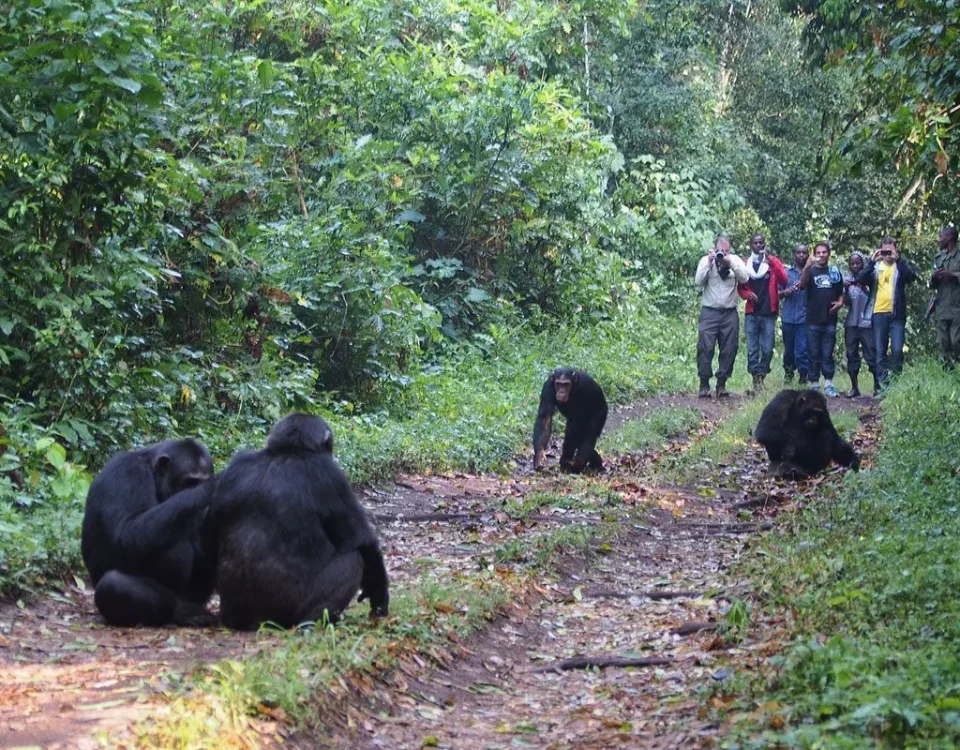
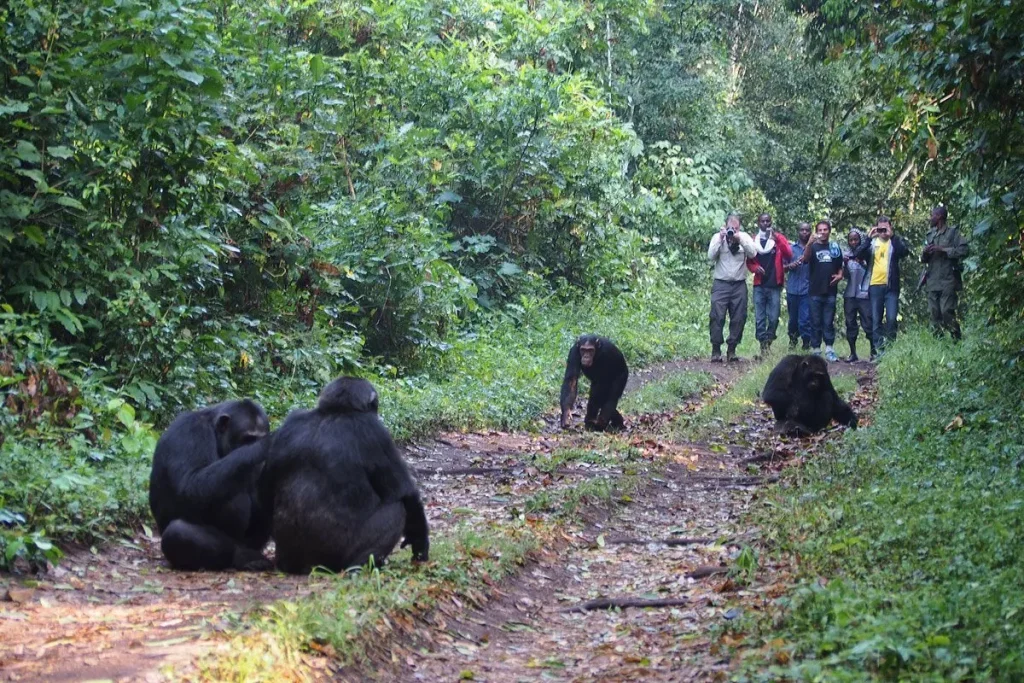
Visitors tracking chimpanzees in Kibale National Park have a genuine chance of observing tool-related behavior firsthand, particularly termite fishing near known mound sites or leaf sponge use around forest water sources during drier periods when standing water becomes scarcer. Guides familiar with the resident communities can often anticipate where such behavior is likely, based on the location of known termite mounds along regularly used trails. Witnessing even a brief moment of tool manufacture and use offers trekkers a direct, close-range look at exactly the kind of behavior that first convinced scientists chimpanzees possessed a far richer cognitive world than previously assumed, a finding that reshaped how researchers understand the boundary, or lack of one, between human and animal intelligence.
Pairing a chimpanzee trek focused on tool use with a broader look at the community’s social dynamics rounds out the experience considerably, since tool use rarely happens in isolation from the wider social and political life of the group; a young chimpanzee learning to fish for termites is simultaneously navigating its position within the community’s social hierarchy, an intertwined relationship covered in more depth in our guide to chimpanzee social behavior and what makes it so distinctive. Travelers who spend time with both Kibale’s chimpanzees and Bwindi’s gorillas on the same trip often come away struck by just how differently the two closely related great apes solve the practical problems of forest life, one through patient toolmaking passed down across generations, the other through raw strength, size, and the steady, protective leadership of a silverback.