Red-Tailed and Blue Monkeys: Spotting Guenons in Ugandan Forests
Uganda’s tropical forests support an impressive variety of primates, including mountain gorillas, chimpanzees, colobus monkeys and several smaller forest monkeys.
Among these are red-tailed monkeys and blue monkeys, two interesting members of the guenon group.
Red-tailed and blue monkeys in Uganda are particularly associated with forest habitats in the western part of the country. You may encounter them during guided nature walks, chimpanzee tracking experiences or other forest activities.
Both species spend considerable time in trees, where they search for fruit, leaves, insects and other food.
Although they share similar habitats, their physical appearance, body size and behaviour can help you identify them.
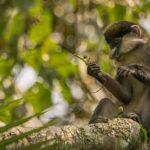
Red-tailed monkeys are generally smaller, with distinctive facial markings and reddish tails. Blue monkeys are larger and usually have darker, greyish coats.
Interestingly, these species sometimes associate with one another while travelling and feeding.
What Are Guenon Monkeys?
Guenons are African monkeys belonging mainly to the genus Cercopithecus.
They occur in different forest and woodland habitats across the continent.
Many guenon species have distinctive facial markings, colourful coats and long tails.
They are generally active during daylight hours and spend considerable time searching for food.
Several guenon species occur in Uganda, including red-tailed monkeys, blue monkeys and related forest primates.
Guenons communicate through vocalisations, facial expressions and body movements.
They also maintain complex social relationships within their groups.
Red-Tailed vs Blue Monkeys: Key Differences
Red-tailed and blue monkeys can sometimes appear similar when moving through thick vegetation.
However, several characteristics make identification easier.
| Feature | Red-tailed monkey | Blue monkey |
|---|---|---|
| Scientific name | Cercopithecus ascanius | Cercopithecus mitis |
| Body size | Generally smaller | Generally larger |
| Tail | Often reddish towards the end | Usually darker |
| Face | Dark with distinctive pale nose marking | Dark, often with pale facial hair |
| Coat | Brownish-grey with contrasting markings | Greyish or dark with bluish tones |
| Habitat | Tropical forests and secondary woodland | Forests and suitable woodland |
| Main food | Fruit, insects, leaves and seeds | Fruit, leaves, seeds and insects |
| Activity | Mainly daytime | Mainly daytime |
| Movement | Mostly through trees | Mostly through trees |
Both species may be encountered within the same forest.
1. Red-Tailed Monkeys in Uganda
Red-tailed monkeys are relatively small, active forest primates.
Their scientific name is Cercopithecus ascanius.
They are also sometimes called black-cheeked white-nosed monkeys.
How to Identify a Red-Tailed Monkey
The easiest identifying features include:
- A reddish or reddish-brown tail
- A dark face
- A noticeable pale marking on the nose
- Light facial hair around parts of the cheeks
- A relatively small body
- Quick movements through vegetation
The tail is particularly useful when the animal is moving away from you.
However, lighting conditions can affect how clearly its colour appears.
Red-Tailed Monkey Behaviour
Red-tailed monkeys spend much of their time in trees.
They travel between branches while searching for food.
Their diet includes fruit, insects, leaves and other plant material.
They often live in social groups containing adult females, offspring and one or more males.
During forest walks, you may notice several monkeys feeding together before moving to another tree.
Red-tailed monkeys can be active and difficult to photograph when they remain high in the canopy.
2. Blue Monkeys in Uganda
Blue monkeys are another important forest primate species.
Their scientific name is Cercopithecus mitis.
Despite their name, these monkeys are not bright blue.
Their coats generally appear grey, dark grey or slightly bluish under certain lighting conditions.
How to Identify a Blue Monkey
Look for:
- A generally dark or greyish coat
- A dark face
- Pale facial markings in some populations
- A larger body than a red-tailed monkey
- A long tail
- Strong climbing movements
Blue monkey appearance varies between regional populations.
This means colour alone is not always enough for identification.
Your guide may use body size, facial features and behaviour to distinguish them.
Blue Monkey Behaviour
Blue monkeys are mainly arboreal, meaning they spend considerable time in trees.
They feed on fruit, leaves, seeds and insects.
Their social groups can remain together while travelling through forest vegetation.
Blue monkeys sometimes produce vocalisations when disturbed or communicating with other group members.
They may also remain relatively quiet while feeding.
Where to See Red-Tailed and Blue Monkeys in Uganda
Several protected forests provide opportunities to observe these guenons.
Kibale National Park
Kibale National Park is one of Uganda’s best destinations for primate watching.
The park supports 13 primate species, including red-tailed monkeys and blue monkeys.
It is particularly famous for chimpanzee tracking.
However, visitors may encounter smaller monkeys during guided forest walks.
Red-tailed monkeys are regularly recorded in suitable parts of Kibale.
Blue monkey sightings depend on the forest area and local population distribution.
Bwindi Impenetrable National Park
Bwindi is best known for mountain gorillas.
However, its forests also support different monkey species.
Blue monkeys and red-tailed monkeys have been recorded in the park.
Visitors may encounter them while travelling along forest trails.
Because the forest is dense, sightings can be brief.
Semuliki National Park
Semuliki protects a distinctive lowland tropical forest in western Uganda.
The area supports several Central African forest species.
Red-tailed monkeys occur in suitable habitats.
The park is particularly interesting for travellers seeking forest primates beyond gorillas and chimpanzees.
Budongo Forest
Budongo Forest is located within the wider Murchison Falls conservation landscape.
The forest is famous for its chimpanzee population.
Red-tailed monkeys also occur here.
Guided forest activities may provide opportunities to observe additional primates.
Kalinzu Forest
Kalinzu Forest is another useful destination for primate watching.
It is located near Queen Elizabeth National Park.
The forest supports chimpanzees and several monkey species.
Red-tailed and blue monkeys have been studied in the Kalinzu forest landscape.
Sightings depend on the route, weather and animal movements.
Why Do Red-Tailed and Blue Monkeys Sometimes Travel Together?
Researchers have documented mixed-species associations involving red-tailed and blue monkeys.
This means individuals from the two species sometimes remain near one another while feeding or travelling.
Such associations may provide several possible benefits.
Detecting Predators
More animals observing their surroundings may improve the chances of detecting danger.
Different species may respond to alarm calls or movements made by nearby monkeys.
However, the benefits depend on the circumstances.
Finding Food
Both species use forest food resources, including fruit.
Travelling near another species may influence movement and feeding opportunities.
Researchers have also found that mixed-species associations can create competition and additional travelling costs.
Therefore, these interactions are more complex than simply cooperating for protection.
Sharing Forest Space
Red-tailed and blue monkeys may use overlapping areas of forest.
They can encounter one another without permanently forming a single social group.
Each species maintains its own social relationships.
What Do Red-Tailed and Blue Monkeys Eat?
Both species consume a variety of forest foods.
Their diets commonly include:
- Wild fruits
- Young leaves
- Seeds
- Flowers
- Insects
- Other available plant material
Food availability changes throughout the year.
During periods when certain trees produce fruit, monkeys may spend considerable time feeding in those areas.
Your guide may identify trees commonly visited by forest monkeys.
However, feeding locations vary, so sightings cannot be guaranteed.
Best Time to Spot Guenons in Uganda
Red-tailed and blue monkeys can be observed throughout the year.
Both are mainly active during the day.
Early morning and late afternoon forest walks may provide useful opportunities to observe primate activity.
However, weather, feeding behaviour and forest conditions influence sightings.
Dry Seasons
Uganda’s commonly recognised drier periods include June to August and December to February.
Forest trails may be easier to walk during these months.
However, rain can occur at any time in tropical forests.
Rainy Seasons
Rainy periods can produce muddy trails and slippery vegetation.
Nevertheless, forest monkeys remain active.
Food availability and animal movements may change with the seasons.
Choose your travel period according to the overall safari itinerary rather than expecting guaranteed monkey sightings in one particular month.
Tips for Spotting Red-Tailed and Blue Monkeys
Finding small forest monkeys requires patience.
The animals often remain above eye level and can disappear quickly among branches.
Follow these practical recommendations:
- Look upwards: Check branches and the middle forest canopy.
- Listen carefully: Movement and vocalisations can reveal nearby groups.
- Use binoculars: They help identify facial markings and tail colours.
- Walk quietly: Sudden noise may disturb feeding animals.
- Watch for movement: Shaking branches may indicate travelling monkeys.
- Ask your guide: Local guides recognise important feeding areas.
- Carry a camera: A zoom lens helps photograph animals high in trees.
- Allow enough time: Rushing through the forest reduces observation opportunities.
Never feed wild monkeys or attempt to attract them with food.
Photography Tips for Forest Guenons
Photographing guenons can be challenging because of their quick movements.
Forest lighting also changes between shaded areas and open sections of canopy.
A camera with a suitable zoom lens can help.
Use a faster shutter speed when monkeys move between branches.
Avoid flash photography where prohibited.
For identification photographs, try capturing the face, tail and overall body shape.
These features can help distinguish similar-looking species later.
Combining Guenon Watching With Other Primate Activities
You do not necessarily need a separate safari dedicated to guenons.
Red-tailed and blue monkeys can be observed during broader forest wildlife experiences.
For example, a visit to Kibale National Park can combine chimpanzee tracking with guided nature walks.
A Bwindi safari may provide opportunities to see monkeys before or after mountain gorilla trekking.
You can also combine Kalinzu Forest with a wildlife safari in Queen Elizabeth National Park.
These combinations allow you to observe different primates without arranging separate journeys to every forest.
Conservation Challenges Facing Forest Guenons
Red-tailed and blue monkeys depend on suitable forest habitats.
Habitat loss and fragmentation can affect their movements and food resources.
Illegal hunting and human disturbance may also threaten populations in some areas.
Protecting forests is important for maintaining healthy primate communities.
Responsible tourism can contribute to conservation through park fees, local employment and support for protected areas.
Visitors should remain on authorised trails, avoid feeding wildlife and follow guide instructions.
Frequently Asked Questions
Are red-tailed monkeys common in Uganda?
They occur in several Ugandan forests and can be relatively easy to observe in suitable habitats, particularly around Kibale.
Are blue monkeys actually blue?
No. Their coats are mainly greyish or dark, sometimes appearing slightly bluish.
Can red-tailed and blue monkeys live together?
They may associate in mixed-species groups temporarily, but each species maintains its own social organisation.
Where is the best place to see both species?
Kibale National Park is a useful destination because both species are recorded there, although sightings vary.
Are guenon monkeys dangerous?
They generally avoid direct contact with people, but they are wild animals. Never touch, feed or approach them closely.
Red-tailed and blue monkeys are interesting members of Uganda’s forest primate communities.
Their facial markings, coat colours, body sizes and behaviour provide useful identification clues.
Kibale National Park is an excellent starting point for observing guenons, while Bwindi, Semuliki, Budongo and Kalinzu offer additional opportunities.
With patient observation and an experienced guide, you can learn to recognise these monkeys and appreciate their role in Uganda’s tropical forests.