
A Family Far Bigger Than Its Two Most Famous Members
Taxonomists currently recognize well over a dozen distinct primate species across Uganda, Kenya, Tanzania, and Rwanda alone, a figure that continues to shift slightly as genetic research refines the boundaries between closely related subspecies and populations once assumed to be identical.
Mountain gorillas and chimpanzees rightly dominate East Africa’s primate tourism, drawing visitors from around the world to Uganda, Rwanda, and DR Congo specifically to encounter our closest living relatives. Yet this focus on two exceptional species obscures a considerably richer picture: East Africa is home to dozens of additional primate species, ranging from tiny, nocturnal bushbabies to boldly patterned monkeys forming some of the largest troops in the primate world. Understanding this broader diversity reveals an entire dimension of East African wildlife that even repeat safari visitors frequently overlook, tucked into forest canopies and grassland margins well beyond the famous trekking circuits built around gorillas and chimps.
The Colobus Monkeys: Forest Acrobats
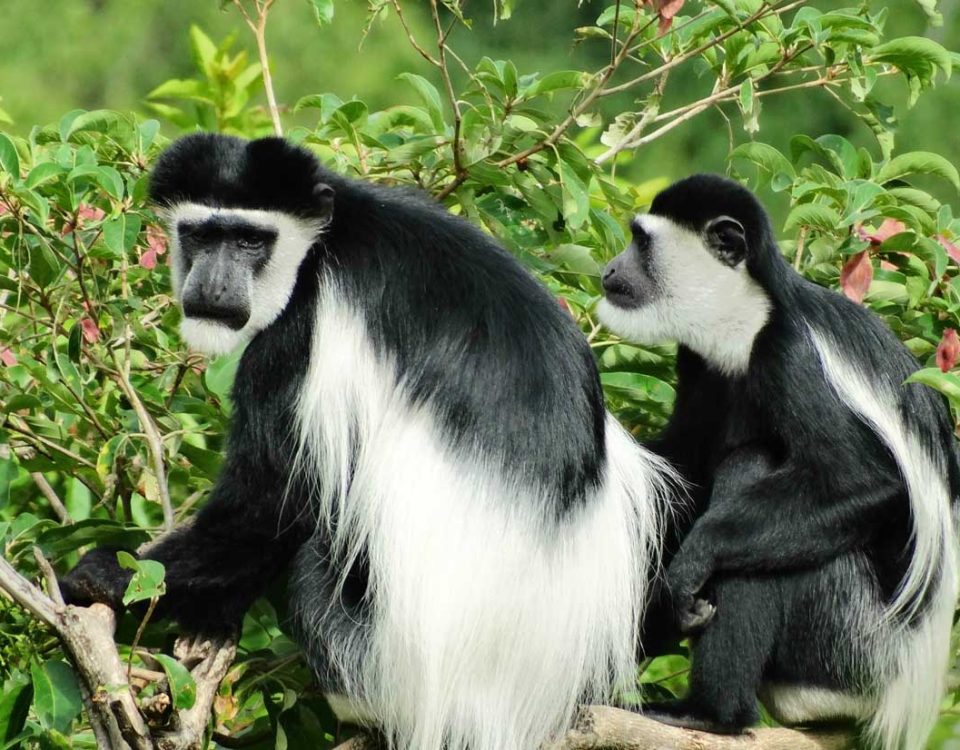
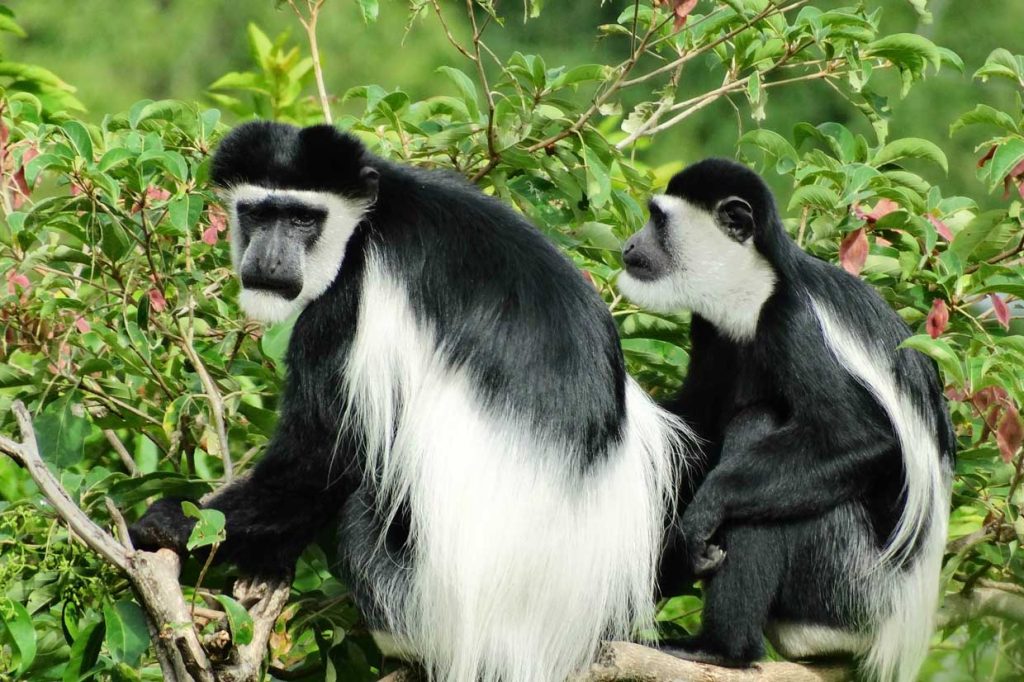
Black and white colobus monkeys, distinguished by their long, flowing white fur cascading from otherwise jet-black bodies, rank among East Africa’s most visually striking primates, and their remarkable arboreal agility, leaping distances exceeding ten meters between forest canopy branches, makes them a consistently rewarding sighting across forested parks throughout the region. A close relative, the red colobus, considerably more vulnerable across much of its range, survives in more fragmented populations, including the notable Zanzibar red colobus found within Jozani Forest, a species covered in dedicated detail within our guide to Zanzibar’s Jozani Forest and its red colobus population. Our companion piece focused specifically on the colobus monkey’s distinctive black-and-white acrobatics covers this remarkable species in considerably more behavioral depth for travelers particularly drawn to this striking forest specialist.
Vervet and Blue Monkeys: The Common Companions
Vervet monkeys rank among the most frequently encountered primates across East Africa’s savannah and woodland habitat, instantly recognizable by their grey-brown coats and, in adult males, distinctive bright blue scrotal coloring believed to play a role in signaling social status and reproductive fitness within troop hierarchies. Vervets display genuinely sophisticated vocal communication, using distinct alarm calls that differ specifically according to predator type, a call warning of an approaching leopard triggers different evasive behavior than a call warning of an eagle or snake, a level of semantic specificity in animal communication that has made vervet alarm calls one of the most extensively studied examples of non-human vocal communication in primatology. Blue monkeys, favoring denser forest habitat than the more adaptable vervet, form similarly complex social groups and are frequently encountered alongside colobus and red-tailed monkeys within East Africa’s forest reserves.
The Distinctive Red-Tailed and L’Hoest’s Monkeys
Uganda’s forest parks host several additional guenon species rarely encountered by casual visitors, including the red-tailed monkey, named for its distinctive rust-colored tail and marked by a striking white, heart-shaped nose patch, and L’Hoest’s monkey, a considerably more terrestrial species favoring dense undergrowth and forest floor foraging over the canopy-dwelling lifestyle typical of most other guenon species in the region. These species, along with the closely related Uganda mangabey, add considerable depth to any forest walk conducted with a knowledgeable naturalist guide, offering a genuinely rich diversity of primate behavior and appearance within a single forest block.
Baboons: East Africa’s Most Adaptable Primate
Olive baboons, the most widespread baboon species across East Africa, demonstrate a genuinely remarkable capacity to thrive across an enormous range of habitat types, from dense forest edge to open savannah and even the fringes of human settlement, a flexibility that has made baboon troops one of the most reliably observed primate groups on virtually any safari itinerary. Baboon troops maintain complex, strictly hierarchical social structures, with rank inherited maternally among females while males typically establish dominance through direct physical competition, a dynamic that produces some of the more visibly dramatic primate social behavior available for observation, from coordinated troop foraging and grooming bonds to occasional serious conflict between rival males contesting leadership.
Baboon Intelligence and Problem-Solving
Baboons display genuinely sophisticated problem-solving ability and social learning, with troops known to develop and transmit specific foraging techniques across generations, including methods for safely accessing thorny or otherwise well-defended food sources. This adaptability, combined with the species’ comfort operating close to human activity, has occasionally created genuine human-wildlife conflict around lodges and agricultural land bordering baboon territory, a manageable but persistent challenge for communities and conservation managers across much of East Africa’s baboon range.
Golden Monkeys and the Region’s Rarest Primates
Restricted almost entirely to the bamboo forests of the Virunga Mountains, the golden monkey represents one of East Africa’s most geographically limited primate species, a genuinely spectacular animal whose vivid orange-gold coat and playful, highly social troop behavior make it an increasingly popular addition to gorilla trekking itineraries across Rwanda, Uganda, and DR Congo. Its restricted range and specialized bamboo habitat requirements are covered in considerably more depth in our dedicated guide to the golden monkey of the Virunga Mountains, which explores this species’ biology and conservation status as a focused feature in its own right.
The Nocturnal Specialists: Galagos and Pottos
A well-planned forest itinerary that deliberately sets aside time beyond a single gorilla or chimpanzee trek routinely turns up several of these lesser-known species without much additional effort, since most of them share exactly the same forest blocks that already anchor Uganda and Rwanda’s primate tourism circuit, requiring little more than an extra hour with an attentive guide and a willingness to keep looking once the main event has concluded.
Beyond the daylight-active species most visitors encounter, East Africa’s forests host an entirely separate, largely invisible primate community active only after dark. Galagos, commonly called bushbabies for their distinctive, high-pitched calls resembling a crying infant, are small, large-eyed nocturnal primates equipped with powerful hind legs for explosive vertical leaping between branches, hunting insects and foraging for gum and fruit under cover of darkness. The potto, an even more secretive nocturnal species found in select forest habitat, moves with remarkably slow, deliberate precision, relying on camouflage and stillness rather than speed to avoid predators, a lifestyle strategy that makes confirmed sightings genuinely rare even for experienced night-walk guides specifically searching for the species.
Patas Monkeys and the Region’s Grassland Specialists
While most East African primates favor forest habitat to some degree, the patas monkey has evolved a genuinely unusual specialization for open, semi-arid grassland, becoming the fastest primate on Earth as a direct adaptation to life in terrain offering minimal cover from predators. Capable of sprinting at speeds exceeding 50 kilometers per hour, patas monkeys rely on this exceptional ground speed rather than the tree-climbing escape strategy favored by nearly all their forest-dwelling relatives, foraging across grassland and scattered acacia woodland in northern Kenya and Uganda in social groups typically dominated by a single adult male overseeing a larger group of related females and young. This ground-based, savannah-adapted lifestyle makes the patas monkey one of the more genuinely distinctive outliers within East Africa’s primate family, a species whose entire evolutionary strategy diverges sharply from the canopy-dependent behavior typical of nearly every other regional monkey species.
Mangabeys and Their Overlooked Forest Range
Grey-cheeked mangabeys, large, robust forest primates often mistaken by inexperienced observers for a type of baboon given their similar size and terrestrial foraging habits, inhabit several of Uganda’s major forest parks, moving through both canopy and forest floor in search of fruit, seeds, and invertebrates. Their loud, distinctive whooping calls, used to maintain contact between troop members across dense forest terrain, are frequently heard well before the animals themselves come into view, another example of how much of East Africa’s primate diversity announces itself acoustically long before it becomes visible to a patient, attentive listener.
Why This Diversity Matters
East Africa’s broader primate community plays a genuinely important ecological role extending well beyond its considerable tourism value, with fruit-eating species like colobus and guenon monkeys serving as crucial seed dispersers that help regenerate forest habitat across the region, while nocturnal insectivores like galagos contribute meaningfully to natural pest control within forest ecosystems. Conservation programs increasingly recognize this broader primate diversity as an important complement to gorilla and chimpanzee-focused protection efforts, and our broader overview of primate conservation across East Africa covers the wider regional picture in more detail, including how habitat protection benefiting headline species like gorillas frequently provides meaningful indirect protection for dozens of less famous primate neighbors sharing the same forest ecosystems.
For travelers willing to look beyond the two species that first drew them to the region, East Africa’s forests offer a genuinely rich, multi-layered primate-watching experience, one where a single guided forest walk might reveal colobus monkeys leaping overhead, a baboon troop foraging nearby, and, for the especially patient and fortunate, the fleeting glimpse of a bushbaby’s eyes reflecting a torch beam deep within the darkness of the canopy above. Gorillas and chimpanzees may remain the headline act, and understandably so, but the supporting cast turns out to be every bit as worth the price of admission for travelers curious enough to look past the two names already on the poster.