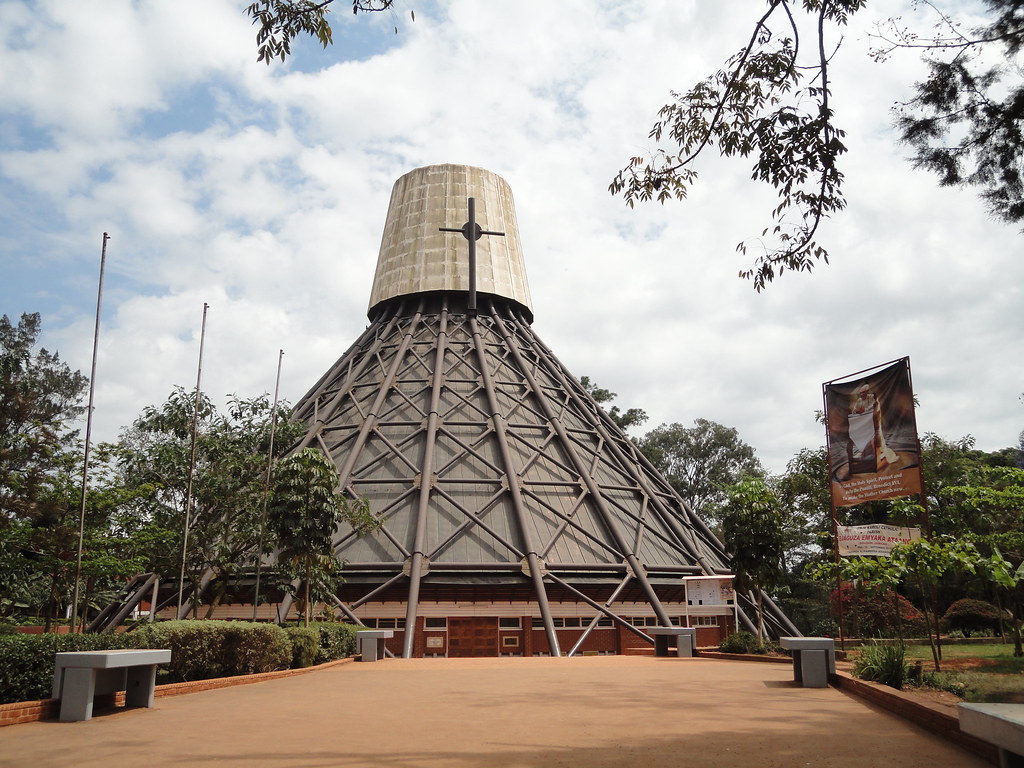

Namugongo Shrine is located at Namugongo, Kira Municipality Wakiso District, in the Central Uganda. Namugongo Shrine is located approximately 14 kilometers (9 mi), by road, northeast of the central business district of Kampala, Uganda’s Capital and largest city in that East African country. Namugongo is a blessed site; well known as the Uganda Martyrs Shrine, which is for everyone’s interest in Uganda’s faith tourism while on the Uganda safari. Namugongo Shrine stands tall with the amazing ancient cathedral whose structural architectural design derives its inspiration from the African Hut. The Uganda martyrs were killed quite a long time ago, about decades ago, in Uganda the Namugongo Shrine it is believed that the Namugongo destination that it’s a place where King Mwanga of Buganda killed the martyrs by burning them, that is 45 Christian martyrs were brutally murdered between 1885 and 1887.
The 45 Uganda Martyrs were executed between the years 1885 and 1887, 23 Anglicans and 22 catholic converts. The murder of these martyrs occurred partly in different places. Twenty-two Catholics converts were murdered at Namugongo. The event has since inspired many Ugandans to form a strong sense of faith which is partly attributed to the heroic acts recorded in the chronicles of the Uganda martyrdom of the 45 Uganda natives.
Namugongo Shrine
The Uganda martyrs shrine at Namugongo was constructed in 1957 and it was finally finished to be constructed in 1967, thanks to the Lt.Cardinal Emmanuel Nsubuga, who was the author of the construction project, the opening ceremony was attended by the pope himself represented by the eminence Sergio cardinal pignedoli on third June, and this is the reason to why the celebration of the Uganda Martyrs at the Namugongo Shrine is celebrated on every 3rd June annually in Uganda.
List of the Uganda Martyrs.
- Yusuf Rugarama.
- Kakumba Makko.
- Serwanga Nuwa.
- Balikunddembe Mukasa.
- Mukasa Musa.
- Kaggwa Anderea.
- Ngondwe Posiano.
- Ssbuggwawo Denis.
- Bazzekuketta Antanansio.
- Gonza Gonzaga.
- Mbwa Eriya.
- Muddu-aguma.
- Mulumba Matiya.
- Muwanga Daudi.
- Kayizza Kibuuka.
- Mawaggali Nowa.
- Mayajja Kitoogo.
- Muwanga.
- Lwanga Karoli.
- Baanabakintu Lukka.
- Buuzabalyawo Yakobo.
- Gyaviira.
- Kibbuka Ambrosio.
- Kiriggwajjo Anatoli.
- Kiriwawanvu Mukasa.
- Kiwanuka Achileo.
- Kizito.
- Lugido Mukasa Adolofu.
- Mugagga.
- Sserunkuuma Bruno.
- Tuzinde Mbaga.
- Kadoko Alexanda.
- Mubi-Azaalwa.
- Munyanyabyangu Robert.
- Kifamunnyanja.
- Kiwanuka Giyaza.
- Kizza Frederick.
- Kwabafu.
- Muwanga Njigija.
- Lwakisinga Mukasa.
- Lwanga.
- Nakabandwa Danieri.
- Wasswa.
- Walukagga Nuwa.
- Muzeeyi Jean-Marie
The forgotten Muslim martyrs.
Long before the 45 Uganda martyrs were killed, an estimate of about 70 Muslims had been killed under the orders of the Kabaka Mutesa I. Their murder came after several tales of the strict observance of the Muslim laws prohibiting eating meat. Kabaka Mutesa I was a Muslim. He became an Imam because of his love for the Muslim religion. He, however, feared circumcision, and this made his subordinates criticize him. The Muslim martyrs refused to eat meat slaughtered by the uncircumcised Muslims and non-Muslims .These martyrs were accused of treason and were lynched at Namugongo. Muslims martyrs were recognized during Iddi Amin reign after realizing martyr talks were based on Christians .A mosque was constructed near the Namugongo for the Muslim martyrs.
Who was the first Uganda Martyr to be killed?
Yusuf Rugarama, Nuwa Serwanga and Makko Kakumba were the first Uganda Martyrs. The execution of the three was done on 31 January 1885, just a year after Kabaka Mwanga the second had successed his father, Later on that year, Bishop Hannington, on the returning to Uganda, was also murdered. Joseph Mukasa was the first Catholic Uganda Martyr. His execution happened in January under the suggestions of Katikiro Mukasa. Katikiro Mukasa received a hint that Joseph Mukasa would become a king. Katikiro, therefore, developed jealousy, grudge and hatred towards Joseph Mukasa.
Why were the Uganda Martyrs killed?
The major reason to why the murder of each martyr varies, thus they have created a consideration debate. Some martyrs went missing when summoned by Kabaka. It has also been recorded that Kabaka executed Uganda Martyrs for lack of submission to his sexual advances. Something that depicted that Kabaka was a gay, subjects who had denounced Christianity as their faith were spared from death.
Also Mwanga summoned the martyrs and asked for those who love to pray to stand on one side. Most of them being the youths, stood aside and declared themselves as worshippers of the Christian religion. Their age bracket approximately ranged from 10 to 30, and they were later executed.
The youngest Uganda Martyr.
Kizito was the youngest Uganda martyr, he was burned alive on the order of King Mwanga 11 of Buganda on 3rd June, 1886 in Namugongo.
How the Uganda martyrs were killed.
The Uganda martyrs were beheaded, tortured, and burnt alive until their death, the burning of the Uganda martyrs began at Gombolola, Mengo, the place of the sacred fire, and ended at Nakiyanja, the site of execution. The holy fire never went off unless a King died and was reignited on the entry of another King. Ssenkole who was the deputy executioner managed the holy fire. He took ash of the killed to use it to protect the king from the dead spirits.
Ssenkole would bring fire on the day of the execution using the reeds, though not up to the place of performance. The blood of the executed was not to be spilled at Nakiyanja. Family members were not allowed to bid farewell to their loved ones in Nakyinja. Farewells were done at the present-day place, Kyaliwajjala.The first was ignited to each condemned while cursing them that disobedience to Kabaka and al Buganda spirits killed them.
Namugongo shrine is not only good for the Christian life of the Uganda’s only, but also other parts of the world that is a lot of people pilgrim from the different countries to come and honor the Uganda Martyrs. Despite the vital of the martyrs to the Christians, the shrine has led to the development of the 3rd June is the best time for business around the shrine in Namugongo, a lot of lodges have been constructed around the shrine to provide accommodation for the pilgrims.
Human beings should embrace respecting each other’s religion. Respecting each other’s religion ensures peace and harmony amongst ourselves. Freedom of worship, this helps attain humane goals that help better that future. The Namugongo shrine has also given the greater contribution to the tourism industry in Uganda, thus many of the tourists visit the country, find time to take a Kampala city tours and also check out the Namugongo shrine.
Uganda Travel Guide — The Pearl of Africa
Uganda is one of Africa’s most rewarding and underrated destinations. Winston Churchill’s description of Uganda as the « Pearl of Africa » — inspired by its extraordinary combination of landscapes, wildlife, and people — remains as apt today as when he coined it in 1908. The country packs an astonishing range of experiences into a relatively compact area: snow-capped mountains, vast savannahs, dense tropical rainforests, the source of the Nile, and some of the world’s most remarkable wildlife.
Uganda shares borders with Kenya, Tanzania, Rwanda, the Democratic Republic of Congo, and South Sudan, and sits astride the equator in East-Central Africa. The capital, Kampala, is a vibrant, growing city that serves as the gateway to Uganda’s national parks. Most wildlife safaris begin and end in Kampala or at Entebbe International Airport, 45 minutes south of the city.
Uganda’s Key National Parks and Wildlife Areas
- Bwindi Impenetrable Forest: UNESCO World Heritage Site and home to over half the world’s mountain gorillas. Four trekking sectors: Buhoma, Ruhija, Rushaga, and Nkuringo.
- Queen Elizabeth National Park: Uganda’s most visited park, famous for tree-climbing lions in the Ishasha sector, boat cruises on the Kazinga Channel, and diverse savannah and forest habitats.
- Murchison Falls National Park: Uganda’s largest park, home to the world’s most powerful waterfall. Excellent for elephants, giraffes, buffalo, hippos, crocodiles, and shoebill storks on the Nile.
- Kibale Forest National Park: The world’s best chimpanzee trekking destination, also home to 12 other primate species and superb birdwatching.
- Kidepo Valley National Park: Uganda’s most remote and arguably most spectacular park, bordering South Sudan. Wild, untouched, and home to species found nowhere else in Uganda including cheetahs and caracals.
- Mgahinga Gorilla National Park: In the Virunga Mountains, offering gorilla trekking, golden monkey trekking, and volcano hiking in a compact, accessible park.
Practical Uganda Travel Information
Visa and entry requirements
Uganda offers an e-visa for most nationalities, applied online at visas.immigration.go.ug. East African Community citizens are exempt. The East Africa Tourist Visa (covering Uganda, Kenya, and Rwanda) is available at the point of entry. A yellow fever vaccination certificate is mandatory for entry.
Currency and costs
The Ugandan Shilling (UGX) is the local currency. USD is widely accepted in tourist areas. Mid-range safari lodges cost USD 150–350 per person per night. Budget accommodation in Kampala starts from USD 20–40. Gorilla permits (USD 800) are the single largest expense for most visitors.
Getting around Uganda
Most visitors use private safari vehicles (included in tour packages) or hire a driver-guide. Public minibus taxis (matatus) connect major towns but are not suitable for wildlife areas. Charter flights from Entebbe to Kihihi, Kisoro, Kasese, or Pakuba significantly reduce overland travel times on longer itineraries.
Recommended Tours: 9 Days Uganda Wildlife Safari | 7 Days Uganda Safari