Okapi: The Rainforest Giraffe of DR Congo’s Ituri Forest
The okapi ranks among Africa’s most surprising mammals, a close relative of the giraffe sporting zebra-striped legs and living not on open savannah but deep within the dense rainforest of DR Congo’s Ituri region. So elusive that Western science didn’t formally describe the species until 1901, despite local Mbuti and other forest communities having long known it well, the okapi remains one of the continent’s genuine wildlife rarities. This guide covers what makes the species so distinctive and what a visit to its namesake reserve actually involves.
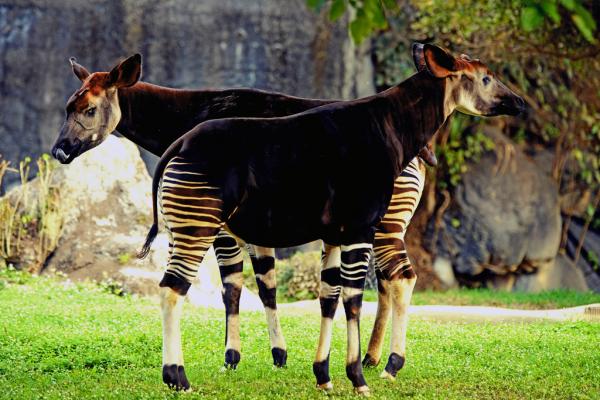
Two okapis, close relatives of the giraffe native to DR Congo’s Ituri Forest. Photo: Grace Tshiyonga, CC BY-SA 3.0, via Wikimedia Commons.
What Exactly Is an Okapi?
Despite its zebra-like striped legs, the okapi is the giraffe’s closest living relative, sharing the same distinctive long, dark, prehensile tongue used for stripping leaves from branches, and a similarly elongated neck, though considerably shorter than its savannah-dwelling cousin. Its reddish-brown body and boldly striped hindquarters and legs provide effective camouflage in the dappled light of dense rainforest, a habitat entirely different from the open plains typically associated with giraffe relatives, and one that partly explains how the species remained undocumented by Western science for so long.
Why the Okapi Stayed Hidden So Long
The okapi’s genuinely solitary, shy nature, combined with the dense, largely impenetrable rainforest it calls home, kept the species hidden from Western naturalists well into the twentieth century, even as rumors of a striped forest creature, sometimes dismissed as a mythical “African unicorn,” circulated among explorers and colonial administrators in the region. Sir Harry Johnston’s 1901 formal description, based on specimens and information gathered with help from local Mbuti communities who had always known the animal, finally confirmed what indigenous knowledge had documented for generations, a pattern repeated with several other “newly discovered” species across colonial-era natural history, and one that’s worth keeping in mind whenever a species is described as recently discovered by Western science.
The Ituri Forest and Okapi Wildlife Reserve
The Ituri Rainforest, in northeastern DR Congo near the borders with Uganda and South Sudan, protects the vast majority of the world’s remaining wild okapi population within the Okapi Wildlife Reserve, a UNESCO World Heritage Site recognized both for its okapi population and its exceptional overall biodiversity. The reserve’s dense, largely intact rainforest also supports forest elephants, chimpanzees, and a wealth of endemic bird species, making it ecologically significant well beyond its namesake species alone.
The Okapi Conservation Project at Epulu
The Okapi Conservation Project, based at Epulu within the reserve, has worked since 1987 to protect okapis and their forest habitat, combining research, community engagement, and a limited captive breeding and rehabilitation program that offers one of the only reliable ways to actually see an okapi up close, given how rarely they’re encountered in the wild even by researchers who study them. Visitors able to reach Epulu can view okapis in enclosures designed to replicate natural forest conditions, alongside learning about the project’s broader conservation and community work in the surrounding region.
The Reality of Visiting: Access and Security Challenges
Visiting the Ituri Forest and Okapi Wildlife Reserve requires acknowledging DR Congo’s genuinely complex security situation, particularly in the country’s eastern regions, where armed group activity has at various times affected travel safety and access to conservation areas including parts of the Ituri region. Travelers seriously considering a visit should work exclusively with operators and conservation organizations maintaining current, accurate knowledge of the security situation, and should treat this as a specialist, carefully planned trip rather than a casual addition to a broader Congo itinerary.
Combining Okapi Viewing With Congo Gorilla Trekking
Travelers already planning a trip to DR Congo for gorilla trekking in Virunga or Kahuzi-Biega National Parks, considerably further south and generally more established for tourism than the Ituri region, sometimes ask about combining this with an okapi visit. In practice, the distance and logistics involved make combining both in one trip genuinely challenging, and most itineraries treat gorilla trekking and an Ituri okapi visit as entirely separate undertakings given how far apart the two regions sit within the country.
Okapi Conservation Status
The okapi is classified as endangered, with population declines driven by habitat loss, illegal mining activity within and around protected areas, and poaching, both for bushmeat and, more specifically, for the species’ distinctively patterned skin. The Okapi Conservation Project and Congolese wildlife authorities continue working to protect remaining habitat and support ranger patrols, though the broader security and governance challenges across the region complicate conservation efforts in ways that don’t affect more accessible East African wildlife destinations to the same degree.
Okapi Behavior and Biology
Okapis are almost entirely solitary outside of mating and mother-calf pairs, marking territory with scent glands on their feet and communicating through infrasonic calls below the range of human hearing, an adaptation that may help individuals stay in contact across dense forest without alerting predators like leopards to their location. Their diet consists of over a hundred documented plant species, including some known to be toxic to other animals, along with fungi and clay from riverbanks, likely consumed for mineral content, a genuinely varied diet suited to the biodiverse forest they inhabit.
Seeing Okapis in Zoos Versus the Wild
Given the extreme difficulty of observing wild okapis, several accredited zoos worldwide maintain breeding populations as part of international conservation efforts, offering most people’s only realistic chance of seeing the species firsthand. While a zoo encounter can’t replicate the experience of the animal’s actual rainforest habitat, these programs play a genuine role in okapi conservation research and public awareness, and travelers unable to visit DR Congo directly can still engage meaningfully with the species through these institutions.
The Broader Ituri Region’s Cultural Significance
Beyond its wildlife, the Ituri Forest is home to indigenous Mbuti and other forest communities whose traditional knowledge of the ecosystem, including their long-standing familiarity with the okapi itself, predates and informed the species’ eventual scientific documentation. Responsible engagement with the region’s conservation story means recognizing this indigenous knowledge as foundational rather than treating the okapi’s 1901 “discovery” as though the animal was previously unknown to anyone.
How the Okapi Compares to Uganda’s Wildlife Highlights
For travelers weighing whether an okapi visit fits their trip, it’s worth understanding how different an experience this is from Uganda’s more accessible wildlife highlights. Where gorilla trekking in Bwindi or golden monkey trekking in Mgahinga involve well-established tourism infrastructure and predictable, bookable experiences, an okapi visit demands considerably more specialized planning, security awareness, and acceptance that even reaching Epulu doesn’t guarantee an easy or straightforward trip in the way Uganda’s parks generally do.
Why the Okapi Matters Beyond Its Novelty
Beyond its striking appearance, the okapi serves as a flagship species for the broader Ituri ecosystem, and its continued survival is closely tied to the health of the forest itself and the communities who depend on it. For travelers unable to make the journey to see one in person, supporting conservation organizations working directly with the species, and simply knowing the genuine story behind this remarkable animal, offers a meaningful way to engage with one of Africa’s most distinctive and least understood large mammals, a species that remains a genuine reminder of how much of the natural world still holds surprises even in an era of satellite mapping and constant global connectivity.
Recommended Tours: 7 Days Rwanda & Uganda Gorilla and Wildlife Safari from Kigali | 5 Days Double Gorilla Trekking Uganda