
My First Time Hearing a Zebra Warning Call Up Close Started as a Peaceful Morning on the African Savanna
Every safari begins with a sense of anticipation because no two game drives are ever the same. You may leave camp expecting to spend the morning searching for lions, elephants, or leopards, yet the memory that stays with you long after the journey ends can come from a completely unexpected moment. My first time hearing a zebra warning call up close was one of those experiences. It did not involve a dramatic chase or a close encounter with a predator. Instead, it was a lesson in how wildlife communicates, survives, and depends on instincts that have been refined over thousands of years.
The morning began just after sunrise as our safari vehicle followed a winding track through an open savanna dotted with umbrella acacia trees. The golden light spread slowly across the landscape, illuminating dew-covered grass that sparkled in every direction. A cool breeze carried the earthy scent of damp soil from rain that had fallen during the night, and the air felt fresh before the heat of the day arrived. Birds filled the silence with a chorus of calls while distant wildebeest grunted somewhere beyond the horizon. Everything about the morning suggested that it would be calm and uneventful.
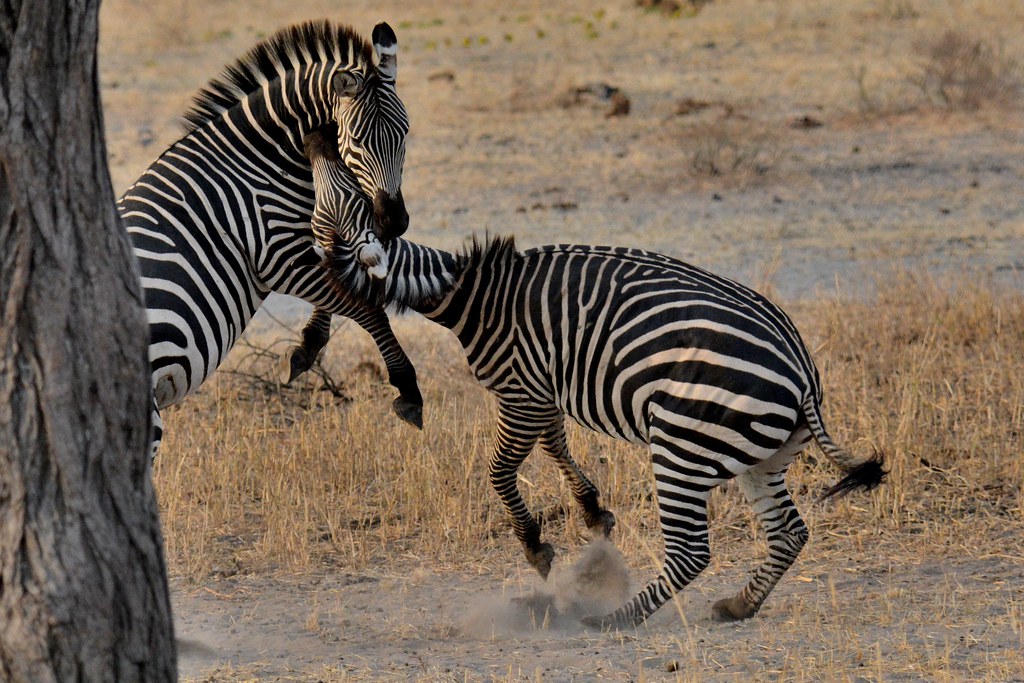
Not far from the road, a family of plains zebras grazed peacefully on a stretch of lush green grass. The herd consisted of one mature stallion, several mares, and a handful of young foals that stayed close to their mothers while occasionally running a few playful circles around one another. The stallion remained watchful even while feeding, raising his head every few moments to survey the surrounding landscape before returning to graze. Nearby, a small group of wildebeest fed alongside the zebras, and an ostrich wandered through the same area, stopping occasionally to peck at insects disturbed by the larger animals. It was a classic East African safari scene, peaceful enough to make anyone believe there was little danger nearby.
Our guide switched off the engine so we could enjoy the sounds of the wilderness without interruption. At first, there seemed to be very little to hear beyond birdsong and the quiet tearing of grass as dozens of mouths grazed steadily across the plain. The silence felt comforting, but our guide quietly reminded us that silence on the savanna rarely means nothing is happening. Wild animals constantly observe one another, and subtle changes in their behavior often reveal more than the human eye can detect.
My First Time Hearing a Zebra Warning Call Up Close Changed the Mood in Seconds
As we continued watching the herd, one adult mare suddenly stopped feeding. Her head rose slowly above the tall grass, and her ears turned toward a patch of dense vegetation several hundred meters away. Nothing seemed unusual from where we sat. We followed her gaze but could see only gently swaying grass and scattered shrubs moving in the breeze. The other zebras continued grazing without concern, and for a brief moment it appeared that the mare might simply have been listening to a distant sound.
Then the calm morning changed in an instant.
The mare released a loud, sharp warning bark that echoed across the open plains. It was a powerful sound that carried much farther than expected, cutting through the morning air with remarkable clarity. Before visiting Africa, I had imagined zebras sounding much like horses, but this call was entirely different. It was shorter, harsher, and filled with urgency. There was no mistaking its purpose.
The reaction from the rest of the herd was immediate. Every zebra lifted its head within seconds. The playful foals stopped running and hurried back toward the adults. The stallion positioned himself between the herd and the direction from which the mare had sounded the alarm, while the other mares gathered the young animals into the center of the group. There was no panic or confusion. Instead, every zebra responded with calm precision, demonstrating the remarkable coordination that has helped the species survive countless predator encounters.
Watching this transformation was fascinating. Only moments earlier, the herd had appeared completely relaxed, yet one warning call was enough to change the behavior of every animal. Their body language communicated just as much as the vocal alarm. Heads remained high, ears rotated constantly, and every pair of eyes focused on the same distant point. It became clear that zebras rely on much more than speed when avoiding danger. Their greatest defense often begins with communication.
What My First Time Hearing a Zebra Warning Call Up Close Taught Me About Zebra Communication
Many safari visitors admire zebras for their striking black and white stripes, yet relatively few realize how sophisticated their communication system actually is. Zebras are highly social animals that depend on strong family relationships throughout their lives. Living in groups offers protection, but it also requires constant communication so that every member understands what is happening around them.
A zebra warning call is one of the most important sounds in the herd. It serves as an immediate alert that potential danger has been detected, even before every animal has identified the threat. Sometimes the warning follows the sight of a predator moving through tall grass. On other occasions, it may result from an unfamiliar scent carried by the wind or a faint sound that humans would never notice. Whatever triggers the alarm, the purpose remains the same. It tells every nearby zebra to stop feeding, become alert, and prepare to react.
The warning call is supported by equally important body language. Raised heads, forward-pointing ears, stiff postures, and fixed attention toward one location reinforce the vocal signal. Young foals learn these behaviors by observing experienced adults, particularly their mothers. Within only a few months of birth, they begin responding automatically whenever they hear the distinctive bark of an alarm call.
This coordinated response greatly improves the herd’s chances of survival. Instead of relying on the senses of a single animal, dozens of individuals work together as one. Every zebra contributes its eyesight, hearing, and sense of smell, making it much more difficult for predators to approach unnoticed.
My First Time Hearing a Zebra Warning Call Up Close Revealed the Remarkable Senses of Zebras
As we remained quietly in the vehicle, our guide explained that zebras often detect predators long before humans have any idea they are nearby. Their hearing is exceptionally sensitive, allowing them to pick up distant sounds carried across open landscapes. Large ears rotate independently, helping pinpoint the exact direction of unusual noises. At the same time, their wide-set eyes provide an expansive field of vision that allows them to monitor much of their surroundings without constantly turning their heads.
Their sense of smell is equally valuable. Wind can carry the scent of lions, leopards, or spotted hyenas over considerable distances, giving zebras precious extra moments to prepare for danger. These heightened senses explain why experienced safari guides pay close attention to zebra behavior. A sudden change in posture or an unexpected warning call often reveals the presence of predators before they become visible.
Although people often focus on the speed of zebras when discussing survival, early detection is usually far more important than running. Avoiding an attack altogether requires much less energy than escaping one after it has begun. This simple reality has shaped zebra behavior over countless generations, making vigilance one of their greatest strengths.
My First Time Hearing a Zebra Warning Call Up Close Finally Revealed the Hidden Predator
Several minutes passed before our guide quietly raised his binoculars and began scanning the area where the mare continued staring. None of us could see anything unusual, despite carefully searching every patch of grass and every shadow beneath the scattered trees.
Finally, the guide pointed toward a small thicket growing beside a dry streambed.
At first, the vegetation appeared completely still.
Then a pair of rounded ears became visible above the grass.
A lioness slowly lifted her head before lowering herself once again into the cover of the vegetation. She had been stalking toward the grazing zebras with extraordinary patience, placing each paw carefully to avoid making unnecessary noise. From our position, she blended almost perfectly with the surrounding grass, explaining why none of us had noticed her.
The mare, however, had detected her several minutes earlier.
Whether she had caught the lioness’s scent, heard the faint rustle of movement, or simply noticed a slight change in the landscape was impossible to know. What mattered was that her instincts had worked exactly as nature intended.
The lioness remained motionless for a short time, studying the herd. Every advantage she had hoped to gain through stealth had disappeared the moment the warning call echoed across the plains. The zebras knew she was there, and every member of the herd was now prepared to react instantly if she moved closer.
The hunt had effectively ended before it had even begun.
Predators on the African savanna depend heavily on surprise. Once prey becomes alert, the chances of a successful attack fall dramatically. Chasing healthy adult zebras across open ground requires enormous amounts of energy, and failed hunts can leave predators exhausted with nothing to show for their effort.
After several minutes of watching the alert herd, the lioness slowly turned away and disappeared into thicker vegetation. The zebras remained cautious for some time before gradually returning to feed, though several adults continued scanning the area long after the immediate danger had passed.
My First Time Hearing a Zebra Warning Call Up Close
g nearby. It was a reminder that life on the African savanna depends on constant awareness, quick communication, and the willingness of animals to trust one another’s instincts. My first time hearing a zebra warning call up close transformed an ordinary morning game drive into one of the most memorable wildlife lessons I have ever experienced. It proved that some of the most remarkable safari moments are not measured by how close you get to a predator, but by how much you learn from the animals that manage to avoid becoming its next meal.
Recommended Tours: 4 Days Bwindi Gorilla Trekking Safari | 8 Days Kenya Wildlife Safari