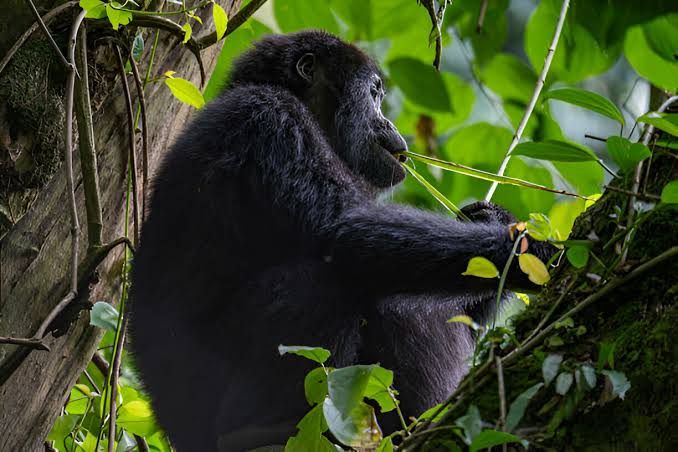
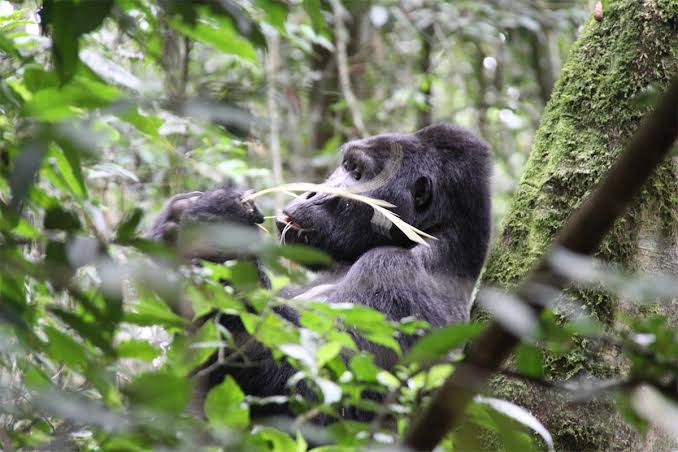
Volcanoes National Park, which spans roughly 160 square kilometers of the Virunga Mountains in northeastern Rwanda and borders Uganda and the Democratic Republic of the Congo, is home to Rwanda’s mountain gorillas.
The Volcanoes National Park is part of a contiguous 433 square kilometer Trans Frontier Conservation Unit that also includes the Virunga National Park in Congo and Mgahinga National Park in Uganda, which protect the Democratic Republic of Congo and Ugandan sectors of the Virunga Mountains, respectively. The Virunga Mountains range, which spans the borders with Uganda and the Democratic Republic of Congo, is home to six extinct and three active volcanoes.
These days, different nations oversee these three national parks independently. However, under Belgian occupation, the Virunga and Volcanoes national parks combined to form Albert National Park before 1960. By decree dated April 21, 1925, the Albert National Park was created in the triangle formed by the Karisimbi, Mikeno, and Visoke Volcanoes, which is said to be a gorilla sanctuary.
It was Africa’s first national park to be designated as such at the time of its establishment. On July 9, 1929, the Institute dup arc national Albert was established by decree. The ultimate borders of Albert National Park, which at the time covered 809,000 hectares, were established by another decree on November 12, 1935.
The remaining portion of the park was in the Congo, with about 8% of it being in what is now Rwanda and is known as the Volcanoes National Park. Despite the urgent issue of overpopulation, Rwanda’s new leaders at the moment of independence vowed to preserve the country’s mountain gorillas, which were already internationally recognized.
The setting of the volcanoes that give the park its name dominates Volcanoes National Park, which ranges in elevation from 2,400 to 4,507 kilometers. One of the most striking and unforgettable sites in East Africa is this range of rugged, free-standing mountains connected by fertile saddles created by hardened lava flows.
Mount Karisimbi near the Congo border is the highest mountain in the series and the highest point in the national park. Mount Bisoke on the Congo border, Mount Sabinyo at the intersection of Rwanda, Uganda, and Congo, and Gahinga and Muhabura on the Uganda border side are the other major peaks in the national park as you move east.
For more than two decades, American primatologist Dian Fossey conducted her groundbreaking research on the behavior of mountain gorillas at the Volcanoes National Park. While there were still some gorillas to conserve, poaching had decreased primarily because to Dian Fossey’s unwavering determination. Dian Fossey was killed in December 1985 while working at the Karisoke Research Center for her unwavering commitment to protecting the mountain gorillas.
The film Gorilla in the Mist, which was shot on site in the Volcanoes National Park, was released three years after Dian Fossey’s passing, bringing her life’s work to the world’s attention. In addition to generating extraordinary interest in the gorilla tourist program that had been developed in the park almost ten years prior, Gorilla in the Mist brought the predicament of the mountain gorilla to the attention of the world. The Volcanoes National Park was the most well-run and well-liked gorilla sanctuary in Africa in 1990, and gorilla tourism was most likely Rwanda’s top source of income from visitors.
When two park employees were slain in an attack on the park headquarters in February 1992, the wheels came off, and Dian Fossey’s research center had to be evacuated. After reopening in June 1993, Volcanoes National Park was evacuated in April 1994 due to the Rwandan genocide.
It was once more offered to tourists in late 1995, but it closed a few months later. Since the permanent resumption of gorilla trekking in July 1999, the number of visitors to the Volcanoes National Park has rapidly expanded.
Volcanoes National Park
Although they are underrepresented in comparison to other forests in Rwanda and Western Uganda, mountain gorillas and golden monkeys are the primary primates found in Volcanoes National Park. Although not much is known about the present state of other large animals, more than 70 species have been identified in Uganda’s neighboring Mgahinga National Park; the majority of these species most likely only exist in the greater Rwandan portion of the Virunga Mountains.
Despite being extremely shy and rarely seen, elephants and buffalo are nonetheless fairly prevalent in this park, based on the quantity of spoor seen on forest routes. The black-fronted duiker, spotted hyena, big forest hog, bush pig, bushbuck, and several tiny predators are also found there. Leopards and the huge yellow-backed duiker are recent extinctions, most likely due to deforestation.
roughly 180 bird species are recognized in Volcanoes National Park, and a 2004 biodiversity survey identified roughly 15 of those species. However, it’s conceivable that a number of additional forest specialists have disappeared since 1980.
While there are at least 16 Albertine Rift endemic species, including handsome francolin, Rwenzori turaco, Rwenzori double-collared Sunbird, Rwenzori batis, strange weaver, dusky crimson-wing, collared apalis, red-faced woodland warbler, and Archer’s ground robin, the vulnerable swamp-dwelling Grauer’s rush warbler is a local specialty.
You will undoubtedly be encouraged to visit Volcanoes National Park if you choose a Rwanda safari tour with All In Africa Safaris, as gorilla trekking is still the most popular activity there. Mountain gorillas aren’t the only attraction in Volcanoes National Park; visitors who used to only stay for one night can now stay for four or five and still find much to do.
From a two-day trek of Karisimbi to a leisurely nature walk to a group of craters later on Mount Bisoke, trekking and mountain climbing are now well-organized. The most interesting addition is that visitors can now see habituated troops of the nearly endemic golden monkey.
Gorilla Trekking in the Democratic Republic of Congo
The Democratic Republic of Congo (DRC) is home to two gorilla species found nowhere else together: mountain gorillas in Virunga National Park and eastern lowland gorillas (Grauer’s gorillas, Gorilla beringei graueri) in Kahuzi-Biega National Park. Both are UNESCO World Heritage Sites.
Virunga National Park – Africa’s oldest national park, established in 1925 – covers 7,900 km² of remarkable ecological diversity, from the volcanic peaks of the Virunga Massif to the glaciers of the Rwenzori Mountains and the tropical lowland forests of the Congo Basin. The park is also home to hippos, elephants, okapis, and the entire cast of Congo rainforest wildlife.
Eastern Lowland Gorillas – A Unique Encounter
The eastern lowland gorilla (Grauer’s gorilla) is the world’s largest subspecies of gorilla, with silverbacks weighing up to 220kg. Found only in the DRC, Grauer’s gorillas are considerably rarer than mountain gorillas – their population has declined by more than 70% since the 1990s due to conflict, habitat loss, and poaching. Kahuzi-Biega National Park in South Kivu offers the only reliable trekking experience with habituated Grauer’s gorilla families.
A gorilla permit in the DRC costs USD 400 per person – significantly cheaper than Rwanda (USD 1,500) or Uganda (USD 800). The experience is raw, off-the-beaten-track, and unforgettable for travellers seeking something genuinely uncommon.
Practical Information for DRC Gorilla Trekking
Getting to Virunga and Kahuzi-Biega
The most common entry point to eastern DRC is via Kigali, Rwanda. Goma – the gateway to Virunga National Park – is just 80km from Kigali. Direct flights from Nairobi and Kampala also serve Goma. Bukavu (gateway to Kahuzi-Biega) is accessible from Goma by road (3-4 hours) or by light aircraft.
Is it safe to trek gorillas in the DRC?
Security in eastern DRC is complex and fluctuates. Virunga National Park and Kahuzi-Biega have experienced periods of closure due to armed group activity. Always check current security conditions with your tour operator and your government’s travel advisory before planning a DRC gorilla trek. Reputable operators with established local security networks are essential.
Recommended Tours: 8 Days Congo Gorillas & Nyiragongo Safari | 5 Days Lowland Gorilla Safari Congo